Fire Door Inspection & Maintenance Guide 2026

Fire Door Inspection & Maintenance Guide 2026

Importance of having compliant fire doors

Compliant and well maintained fire doors will:

■ Hinder the spread of fire throughout a building
■ Hinder the spread of fire, smoke, heat onto escape routes
■ Protect storage areas e.g. Data or combustible materials
■ Provide a minimum of 30 minutes resistance to fire, smoke and heat to compartmentalised safe area

Remember to check for certification

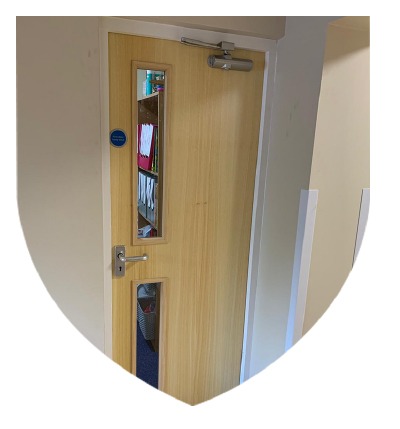
Is there a label or plug on top (or occasionally on the side) of the door to show it is a certificated fire door? You can use the camera your smart phone or a mirror to check. If there is, that’s good news, otherwise report it to whoever is in charge of your building.

* The British Standards Institution has published BS ISO 3941:2026 – Classification of Fires. This introduces Class L for lithium-ion battery fires. However, this class has not yet been incorporated in the BS EN 2 / EN 3 extinguisher fire rating system. (April 2026)
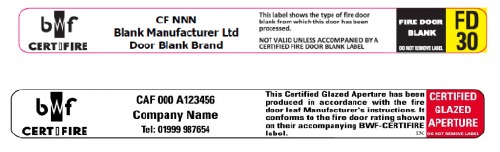
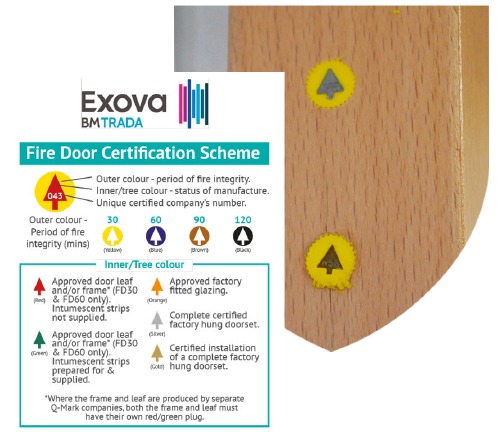
Fire door label
Exova Door Plug

Five Common Door Faults

Missing smoke seals

Over 61% had fire or smoke seals either missing, installed incorrectly or not filling perimeter gaps correctly.
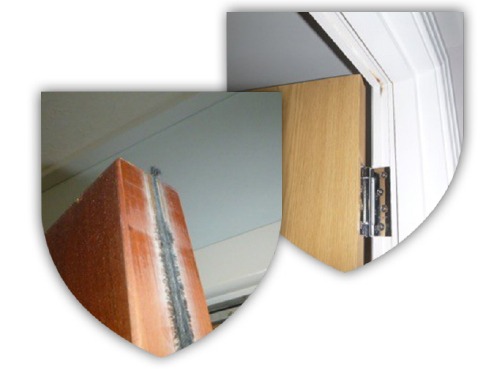
Missing smoke seals
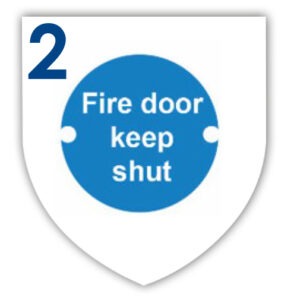
missing signage

Over a third had incorrect or missing mandatory signage.
missing signage
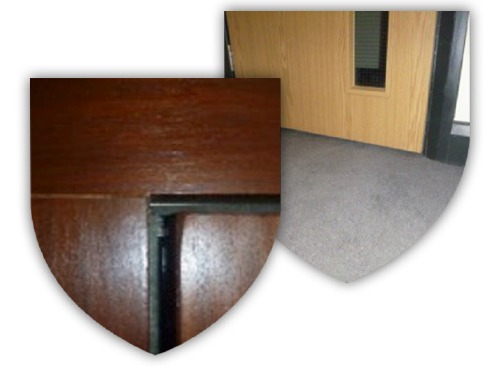
Excessive gaps

More than 230 (34%) fire doors inspected had excessive gaps between the door and its frame (i.e. over 3mm)
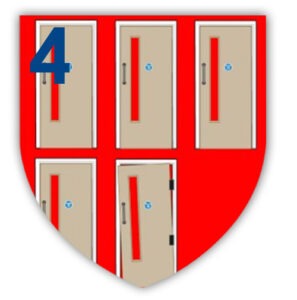
Unsuitable hinges
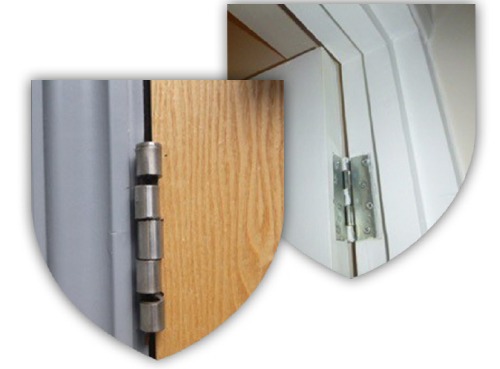
Unsuitable hinges

Almost one in five had unsuitable hinges.
Unsuitable hinges
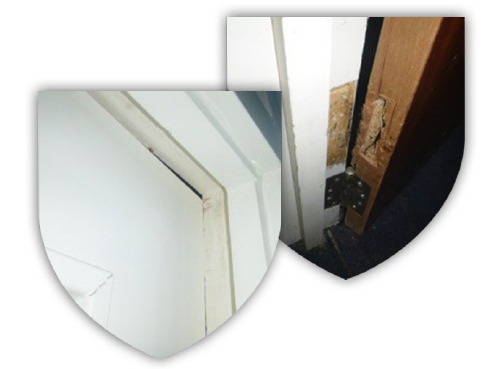
Leaf damage

Over 15% had damage to the door leaf
Leaf damage

Checking Fire Doors

01

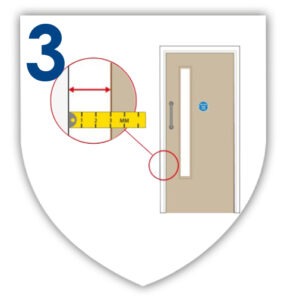
Check the gaps around the top and sides of the door are consistently less than 4mm when closed.

– Use a £1 coin to give a feel for scale, this is about 3mm thick.
– The gap under the door can be slightly larger (up to 8mm is not uncommon), but it does depend on the door – as a rule of thumb, if you can see light under the door, the gap is likely to be too big.
– If the gaps between the door and its frame are too big smoke and fire could travel through the cracks.
– A doors threshold gap should be no more than 10mm, allowing the door to swing unhindered.
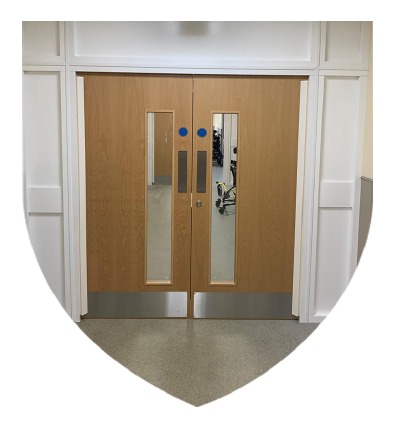
– It’s good news if the door fits the frame and both the frame and door are not damaged. While checking for damage and making sure the frame is fitted securely, look out for the doors certification label or plug. This will confirm if the door is fire resistant to 30 or 60 minutes.
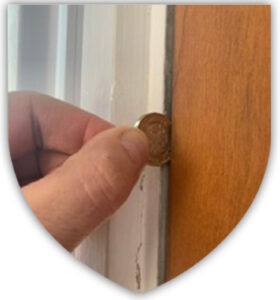

Check gaps

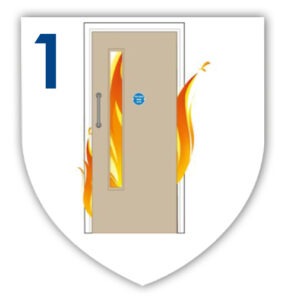
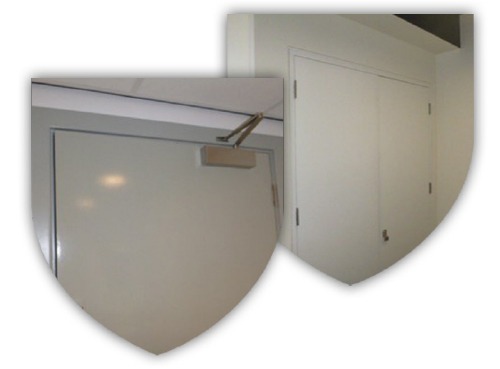
Check that the fire door has a working door closure system and closes correctly as designed.

– Fire doors should be kept closed at all times, or if kept open, should use an automatic release unit when the fire alarm is activated.
– Open the door about halfway, let go and allow it to close by itself.
– Does it close firmly onto the latch without sticking on the floor or the frame?
– A fire door only works when it’s closed. A fire door is completely useless if it’s wedged open or can’t close fully.
– Fire doors that are ‘Kept locked shut’ do not require door closers providing the door is actually kept locked shut!
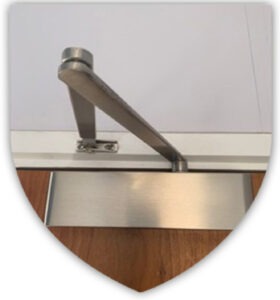

Door closer

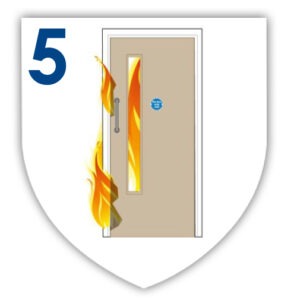
Check that intumescent seals or intumescent cold smoke seals are fitted into a groove in the frame or door.

– Are there intumescent seals or intumescent cold smoke seals around the door or frame?
– If fitted, are they intact with no sign of damage? (Intumescence is a sealing substance that expands in a fire, filling the gap between the door and frame).
– Seals are vital to the fire door’s performance, preventing smoke from passing through the gaps between the door and frame then expanding if in contact with heat, stopping the fire from spreading to other compartments and escape routes.
– Fire doors in older premises may not be fitted with seals but will have one inch door stops.
– See UPGRADING OF FIRE DOORS.
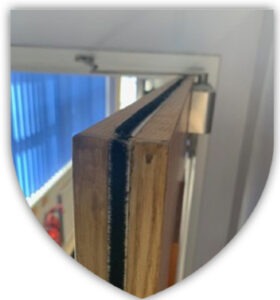

intumescent seals

Check that the door has three hinges.

– Hinges must be the correct type, and should have the correct fire rating.
– Three is critical in helping the door stay in position and not break away from the frame in a fire.
– Are the hinges firmly fixed, with no missing or broken screws?
– Are the hinges showing signs of wear?
– Worn hinges will cause the door to drop and gaps between the door and frame to vary eventually causing the door to not close as designed.
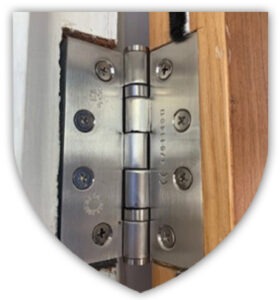

Three hinges ?

Check vision panels have correctly installed glazing which is appropriately fire rated.

– Fire rated glass vision panels must be installed using intumescent seals. Intumescent helps hold the glass in a fire, maintaining its position under heat.
– Without the use of an intumescent seal the glass will collapse allowing the fire to spread!
– Fire rated glass will have a manufacturers logo complete with product compliance information.
– If in doubt contact the door manufacturer or a third party certified door installer / inspector.
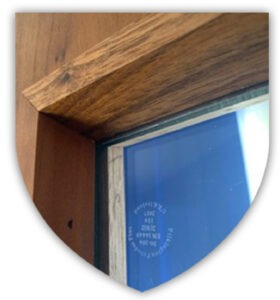

Vision panel glazing

Check that correct door furniture is installed.

– Ensure that the lock and latch holds the door firmly in place. If it does not this should be resolved – as all fire doors must close firmly into the frame.
– Check manufacturers product information when installing new door furniture, the item may require installing with intumescent material so the doors fire resistance is not compromised.
– Only use approved fire rated products when installing new door furniture. CERTIFIRE is an independent third party certification scheme that assures performance, quality, reliability and traceability of fire protection products.
– If in doubt contact the door manufacturer or a third party certified door installer / inspector
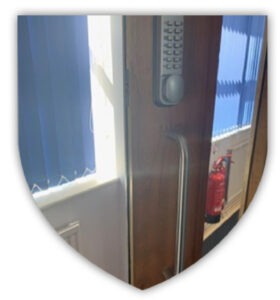

Door furniture

Check that the door has correctly fitted mandatory signage.

– Fire door signage should be positioned at eye level on the door and not on vision panels as this may compromise the fire resistance of the glass.
– Staff, students and visitors can only be expected to use fire doors correctly if instructed.
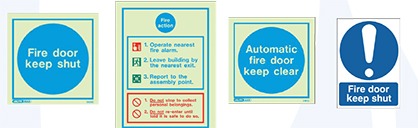
– Cross corridor or room doors opening on to escape routes require ‘Fire door keep shut’ on both faces of each leaf of self closing doors.
– Automatic doors fitted with a device that releases the door in the event of a fire require ‘Automatic fire door keep clear’ placed on the visible side of the door when held open.
– Fire doors without self closing devices i.e. store rooms, risers and services rooms require ‘Fire door keep locked shut’ fixed to the outer door face.
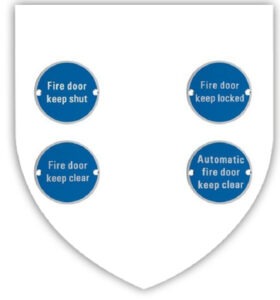
Mandatory door signage

Common Terminology

Description Key
A fire door with 30 minutes integrity and 30 minutes insulation (FD30/30) FD30
A fire door with 60 minutes integrity and 60 minutes insulation (FD60/60) FD60
Smoke Seals (S)
Self Closing-Closed by automatic device MB. See BS 6459 SC
Vision Panel (If in a Fire Door must be FRG) VP
Fire Resistant Glazing (30/60 minutes resistant) FRG
Push Bar PB

Routine fire door inspections and maintenance

BS 9999:2017 Annex I Routine inspection and maintenance of fire safety installations

Daily:
Fire door automatic release mechanisms
All fire doors that are held open by automatic release mechanisms should be released daily.

Monthly:
Automatic opening doors
The operation of fail-safe mechanisms should be tested once a month, either by ”breaking out” the doorset or by simulating failure of the mains power supply, as appropriate. The result of the test should be recorded. Any doors that are found to be faulty should be repaired or replaced.

Doors on hold open devices
The operation of hold open devices should be tested once a month by simulating failure of the mains power supply or operation of the fire detection and alarm system. The result of the test should be recorded. Any doors that are found to be faulty should be repaired or replaced.

Emergency and panic escape doors
The operation of all emergency and panic escape devices, especially on external doors not used for other purposes, should be checked once a month for ease of operation and opening of the door. Weather conditions can effect the door and frame relationship, and therefore the ease of operation of escape devices.

Six-monthly:
All fire doors should be inspected every six month. In particular, it should be ensured that:

a) Heat-activated seals and smoke seals are undamaged;
b) Door leaves are not structurally damaged or excessively bowed or deformed;
c) Gaps between the door leaf and the frame are not so small as to be likely to bind, or so large as to prevent effective fire and smoke-sealing;
d) Hanging devices, securing devices, self closing devices and automatic release mechanisms are operating correctly.

Fire Doors Regulation 10
The Fire Safety (England) Regulations 2022 will make it a legal requirement from 23 January 2023 for
responsible persons for all multi-occupied residential buildings in England with storeys over 11 metres
in height to: undertake quarterly checks of all fire door (including self-closing devices) in the common
partsake – on a best endeavour basis – annual checks of all flat entrance doors (including self-closing
devices) that lead onto a building’s common parts.

For full details, refer to Fact sheet: Fire doors (regulation 10) at the HM Gov Website.
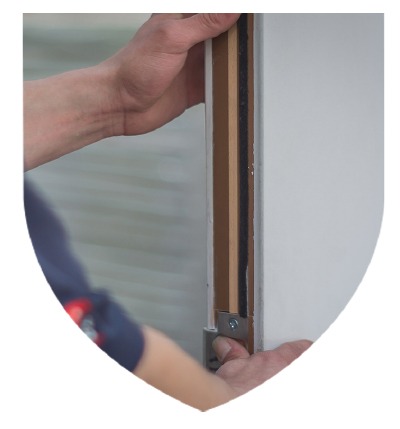
fire door maintenance

Upgrading of fire doors

Upgrading of fire doors

■ Is it worthwhile to upgrade or is a replacement a more effective
alternative?
■ What level of fire resistance is required?
■ Will an upgraded solution satisfy an Enforcement Officer or the
control authority?
■ Has each existing door leaf and frame the potential for being
upgraded?
■ Has the method of improving the burn-through resistance of the
door leaf been proven or does it need assessment by a specialist?
■ Has the door to frame gap been upgraded in terms of fit,
intumescent protection and smoke sealing?
■ Is the frame adequate and sufficiently well sealed into the wall?
■ Is the ironmongery appropriate for use on a fire resisting doorset?

If in doubt about any of the above, contact a competent fire door installer / inspector.
RES Van

Certification Scheme

BM-TRADA Logo

RES are Certified with BM-TRADA.

Scope of certification:

Q-Mark Fire Door Installation
Q-Mark Fire Door Maintenance
Q-Mark Fire Stopping Installation

BM TRADA is a leading provider of third-part certification for fire doors which is why we have invested in becoming a Certificated Company to their Q-Mark schemes.

The BM TRADA Q-Mark Fire Door Installation and Maintenance schemes have been designed to provide reassurance that fire doorsets are being installed and maintained correctly, in accordance with the manufacturer’s instructions or appropriate guidelines.
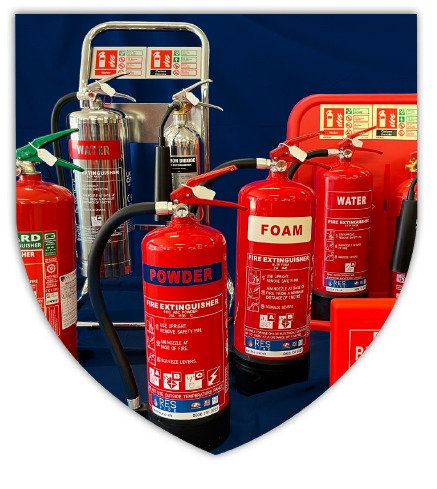
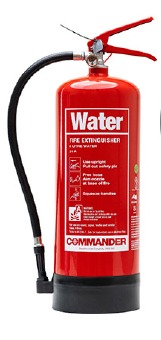
Download Fire Door Inspection & Maintenance Guide 2026

Fire Extinguisher Guide 2026

FIRE EXTINGUISHER GUIDE 2026

Types of Fire Extinguishers

Along with ensuring you have the right types of fire extinguisher, you will also need to make sure that you select the right sizes and weights.

The various types of fire extinguisher put out fires started with different types of fuel – these are called ‘classes’ of fire. The fire risk from the different classes of fire in your business premises will determine which fire extinguisher types you need.

There are 6 main types of fire extinguisher, plus different variants of Water and Dry Powder extinguishers explained in more detail later in the guide.

■ Water
■ Foam
■ Dry Powder
■ Carbon Dioxide (‘CO2’)
■ Wet Chemical
■ Lithium Battery (Specialist)

There is no one extinguisher type which works on all classes of fire.

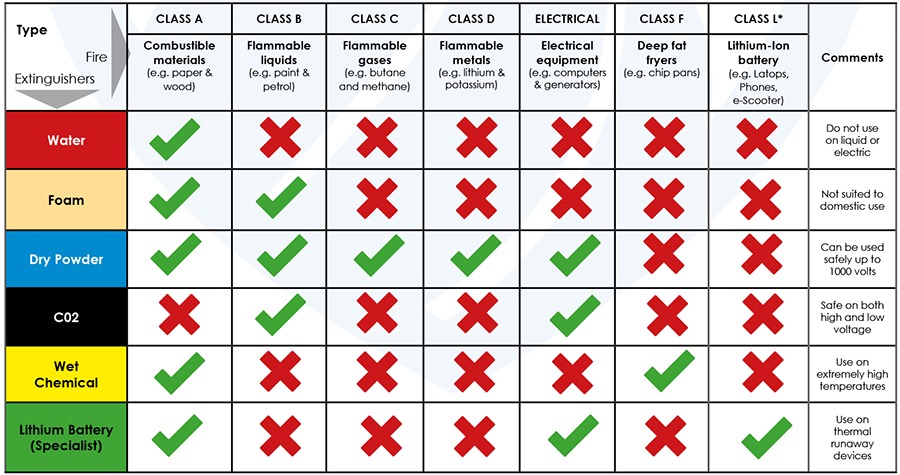
Below is a summary of the classes of fire, and a quick reference chart showing which types of extinguisher should be used on each.

We then provide a detailed explanation of each type of fire extinguisher.

Fire Extinguishers

Fire extinguisher colours

There are 6 fire extinguisher label colours: Red, Cream, Black, Blue, Yellow and *Green.
Each colour represents a different type of extinguisher, used on different types of fires.
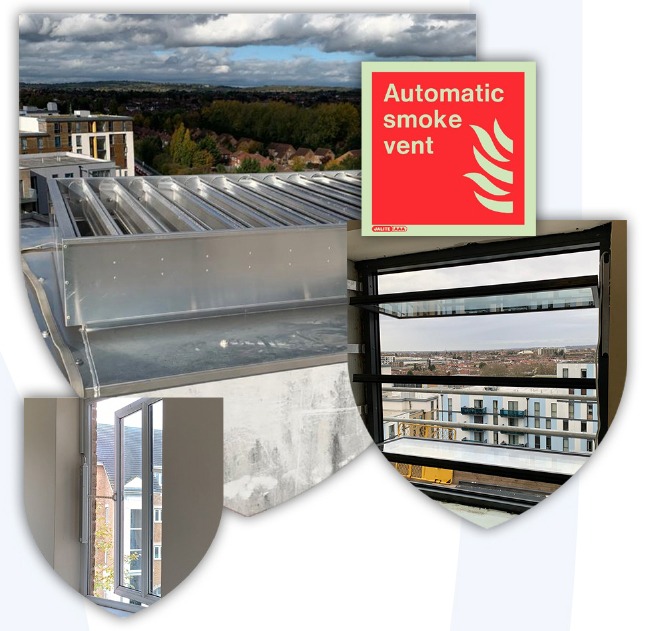
The fire extinguisher colours changed in 1997 to meet British and European Standard BS EN3.
All modern fire extinguishers have a red (or chrome) body, with the identifying colour displayed in a wide band at the top of the extinguisher – as in the image below:

Red: Water

Red: Water

Cream: Foam

Cream: Foam

Black: C02

Black: C02

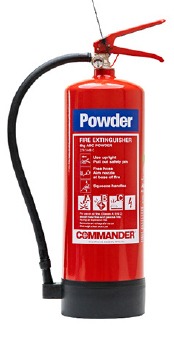
Blue: Powder

Blue: Powder

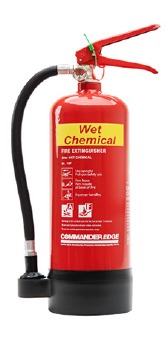
Yellow: Wet Chemical

Yellow: Wet Chemical

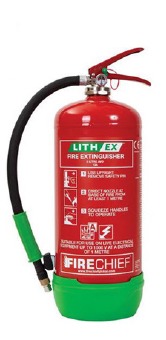
Green: Lithium-ion Battery Fire (LFX/Lith-Ex)

*Green: Lithium-ion Battery Fire (LFX/Lith-Ex)

* The British Standards Institution has published BS ISO 3941:2026 – Classification of Fires. This introduces Class L for lithium-ion battery fires. However, this class has not yet been incorporated in the BS EN 2 / EN 3 extinguisher fire rating system. (April 2026)
Why did the fire extinguisher colours change?

Up until 1997, the body of the extinguisher was usually made up of the entire distinguishing fire extinguisher colour.
For example, Co2 extinguishers would have been completely black, Foam extinguishers would have been completely cream, and powder extinguishers would have been completely blue.

The standard fire extinguisher colour was changed to ‘signal red’ for 2 main reasons.

Firstly, red is the colour associated with both danger and fire and so there is an obvious association with fire extinguishers.
Secondly, red is the colour most easy to see, especially in a darker environment, such as a smoke-filled room.

The only exception to the ‘red’ rule, is chrome extinguishers. Whilst these do not strictly conform to the guidelines, all chrome extinguishers in the UK are ISO 9001 quality supervised and tested against British Standard BS EN3.

We recommend using larger extinguisher ID signs with chrome extinguishers, to make them more visible.

See our separate Fire Safety Signage Guide

The different classes of fire

The different fire extinguisher colours tell you which classes of fire an extinguisher can be used on. Fire is a form of dry heat, but it comes in different forms. There are seven classes of fire: A, B, C, D, ‘Electrical’, F and now L*.

Class A fires – combustible materials:
– These are fires caused by flammable solids, such as wood, paper, and fabric

Class A fires – combustible materials:
– These are fires caused by flammable solids, such as wood, paper, and fabric

Class B fires – flammable liquids:
– These are fires caused by flammable liquids, like petrol, paint, or white spirits

Class C fires – flammable gases:
– These are fires caused by flammable gases, such as hydrogen or methane

Class D fires – combustible metals:
– These are fires caused by metals and chemicals such as magnesium, or potassium

Electrical hazards – electrical equipment:
– These are fires caused by electrical items, like heaters. Once the electrical item has been removed, the fire changes class, which means you can use a different colour fire extinguisher if necessary

Class F fires – cooking oils:
– Typically these are chip pan fires

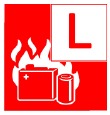
Class L Fires* – Lithium-Ion Battery Fires

Class L Fires* – Lithium-Ion Battery Fires
– Class L fires involve lithium-ion cells and battery packs used in rechargeable devices and
energy storage systems.

Which extinguisher is used for each class of fire? – quick guide

Extinguisher Class Table 2026

Different types of fire extinguisher – a detailed guide

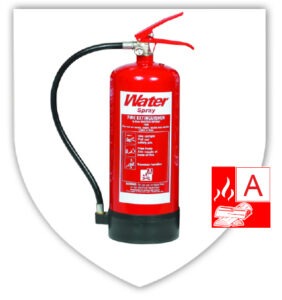
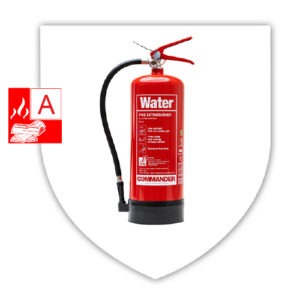
Water Extinguishers

Water fire extinguishers are the most common extinguisher type for class A fire risk.
Most premises will require either water or foam extinguishers.

Extinguisher label colour: Bright Red

Use for: – Organic materials such as:
■ Paper and cardboard
■ Fabrics and textiles
■ Wood and coal

Do not use for:
■ Fires involving electrical equipment
■ Kitchen fires
■ Flammable gas and liquids

How water extinguishers work:

The water has a cooling effect on the fuel, causing it to burn much more slowly until the flames are eventually extinguished.

Types of premises/business who may need water extinguishers:

– Buildings constructed of wood or other organic materials
– Premises where there are organic materials to be found such as:
■ Offices
■ Schools
■ Hospitals
■ Residential properties
■ Warehouses
In fact, most buildings need either water or foam extinguishers.

Where to locate water extinguishers:
– By the exits on a floor where a Class A fire risk has been identified

Water Spray

Water spray extinguishers – what’s the difference?:

Water spray extinguishers are equipped with a spray nozzle, rather than a jet nozzle, meaning a greater surface area can be covered more quickly and the fire put out more rapidly.

Water Spray

Water spray extinguishers – what’s the difference?:

Water spray extinguishers are equipped with a spray nozzle, rather than a jet nozzle, meaning a greater surface area can be covered more quickly and the fire put out more rapidly.

Class A Water Extinguisher

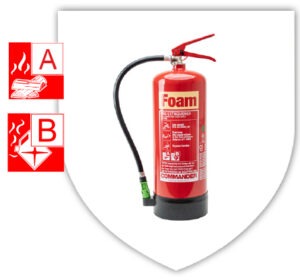
Foam extinguishers

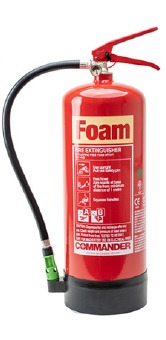
Foam fire extinguishers are most common type of extinguisher for Class B fires, but also work on Class A fires as they are water-based.

Extinguisher label colour: Cream

Use for: – Organic materials such as:
■ Paper and cardboard
■ Fabrics and textiles
■ Wood and coal
■ Flammable liquids

Do not use for:
■ Kitchen fires
■ Fires involving electrical equipment
■ Flammable metals

How Foam extinguishers work:

As with water extinguishers, foam extinguishers have a cooling effect on the fuel. On burning liquids, the foaming agent creates a barrier between the flame and the fuel, extinguishing the fire.

Types of premises/business who may need Foam extinguishers:

– Buildings constructed of wood or other organic materials
– Premises where there are organic materials to be found such as:
■ Offices
■ Schools
■ Hospitals
■ Residential properties
■ Warehouses
– Buildings where flammable liquids are stored
In fact most buildings need either water or foam extinguishers

Where to locate Foam extinguishers:
– By the exits on a floor where a Class A or Class B fire risk has been identified

Foam Extinguishers

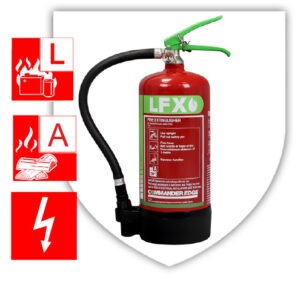
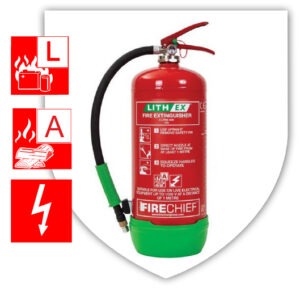
Lithium-Ion battery fire extinguishers*

Water fire extinguishers are the most common extinguisher type for class A fire risk.
Most premises will require either water or foam extinguishers.

Extinguisher label colour: Bright Red

Use for: – Battery powered equipment such as:
■ Mobile phones, laptops, e-scooters, e-bikes

+ Paper and cardboard
+ Electrical hazards

Do not use for:
■ Flammable liquids or gases
■ Flammable metals
■ Kitchen fires

LFX
LFX extinguishers are water-based, meaning they are Fluorine-free, whilst discharging as a foam which quickly absorbs the heat. As a result, the chain reaction which leads to thermal runaway breaks down, cooling down the battery and preventing other cells from overheating.

Suitable for homes, offices, workshops and repair stores with cordless tools, mobile phones, laptops, electric toothbrushes, toys, etc.

Lith-Ex
Using a non-toxic and revolutionary extinguishing agent, AVD (Aqueous Vermiculite Dispersion) is deployed as a mist which then creates a film over the surface which instantly dries to create an oxygen barrier, cools and prevents re-ignition. The Lith-Ex fire extinguisher is the only one which is safe to use on a lithium-ion battery and works even where a powder can’t.

Perfect for vehicles, aviation, marine, medical facilities and any premises with items which have lithium-ion batteries.

LFX Extinguisher
Lith-Ex Extinguisher

Carbon Dioxide (CO2) Extinguishers

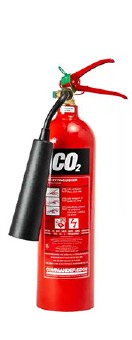
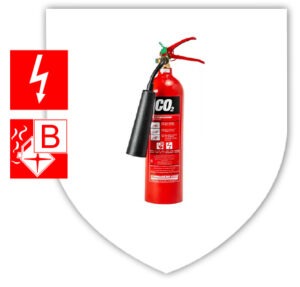
CO2 fire extinguishers are predominantly used for electrical fire risks and are usually the main extinguisher type provided in computer server rooms. They also put out Class B fires (flammable liquids, such as paint and petroleum).

Extinguisher Label Colour: Black

Use for:
■ Flammable liquids, like paint and petrol
■ Electrical hazards – fires involving
electrical equipment

Do not use for:
■ Kitchen fires – especially chip-pan fires
■ Combustible materials like paper,
wood or textiles
■ Flammable metals

How CO2 extinguishers work:

CO2 extinguishers suffocate fires by displacing the oxygen the fire needs to burn.

Types of premises/business who may need foam extinguishers:

– Premises with electrical equipment, such as:
■ Offices
■ Kitchens
■ Construction sites
■ Server rooms

Where to locate CO2 extinguishers:
– Place near to the source of an electrical hazard and/or near the fire exits with a Class A extinguisher where electrical hazards are present.

Carbon Dioxide (CO2) Extinguishers

Dry powder extinguishers

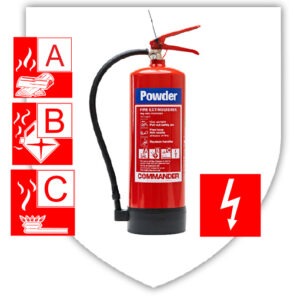
Standard dry powder fire extinguishers are also called ‘ABC’ extinguishers because they tackle class A, B and C fires, however, they are not recommended for use in enclosed spaces. This is because the powder can reduce visibility, be easily inhaled, and also
the residue is very difficult to clean up after, causing damage to electrical equipment.

ABC powder extinguishers can also be used on some electrical fires. Specialist dry powder extinguishers are used for flammable metals.

Extinguisher Label Colour: Blue

Use for: – Organic materials such as:
■ Paper and cardboard
■ Fabrics and textiles
■ Wood and coal
+ Flammable liquids, like paint and petrol
+ Flammable gases, like liquid petroleum gas (LPG) and acetylene
+ Fires involving electrical equipment up to 1000v

Do not use for:
■ Fires involving cooking oil
■ Fires involving electrical equipment
over 1000v
■ or in enclosed spaces, such as offices, hosptals, schools or residential properties
where evacuation can be hindered.

How dry powder extinguishers work:

Dry powder extinguishers smother fires by forming a barrier between the fuel and the
source of oxygen.

Types of premises/business who may need Dry Powder extinguishers:

■ Businesses using flammable gases for chemical processes
■ Premises where welding and flame cutting takes place
■ Garage forecourts
■ Liquid petroleum gas (LPG) dispensing plants
■ Premises with large, commercial boiler rooms

Where to locate Dry Powder extinguishers:
– Place dry powder extinguishers near to the source of the fire risk.

Specialist Dry Powder extinguishers – what’s the difference?:
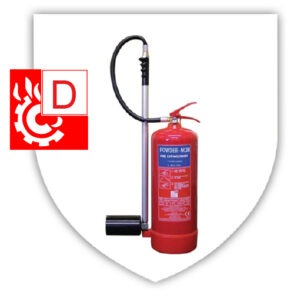
Specialist dry powder extinguishers work in the same way as standard dry powder extinguishers but are for use with flammable metals only. There are 2 types of specialist dry powder extinguishers – ‘L2’ which only tackles lithium fires, and ‘M28’, for all other flammable metal fires.

Dry Powder
Dry Powder Specialist

Wet Chemical Extinguishers

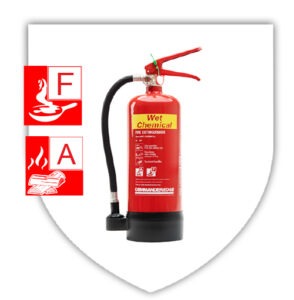
Wet chemical fire extinguishers are designed for use on Class F fires. What are Class F fires? In a nutshell, these involve cooking oils and fats. They can also be used on Class A fires although it is more common to have a foam or water extinguisher for this type of fire risk.

Extinguisher Label Colour: Yellow

Use for:
– Cooking oil/fat fires
– Organic materials such as:
■ Paper and cardboard
■ Fabrics and textiles
■ Wood and coal

Do not use for:
■ Flammable liquid or gas firesl
■ Electrical fires
■ Flammable metals

How wet chemical extinguishers work:

Wet chemical extinguishers create a layer of foam on the surface of the burning oil or fat, preventing oxygen from fuelling the fire any further. The spray also has a cooling effect.

Types of premises/business who may need wet chemical extinguishers:

■ Premises with commercial kitchens

Where to locate wet chemical extinguishers:
– Place near to the source of the fire risk.

Wet Chemical Extinguishers

Fire extinguishers - Options and accessories

P50 Fire extinguishers

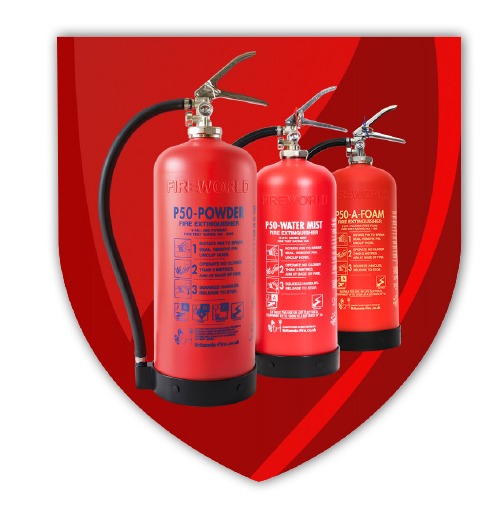
P50 fire extinguishers are low maintenance appliances that require a ten-year refill/service and have a twenty-year life cycle.

They are fully compliant with BS EN3 part 7, however, do not currently meet with British Standard BS 5306 parts 3 or 8. They are also not currently recognised by BAFE within their accreditation scheme BAFE SP101

Available as Powder, Water Mist, Foam and Class F.

More information

P50 Fire extinguishers
Trolley Units

Trolley Units

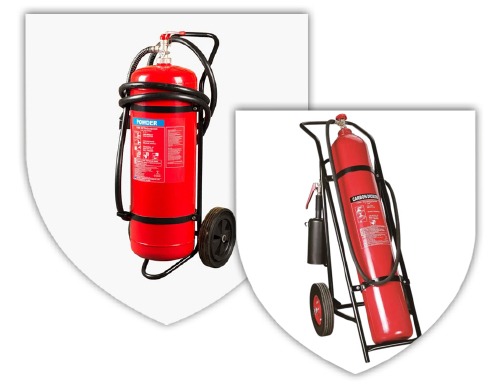
Wheeled trolley units are designed to fight fires in many different environments including warehouses, petroleum sites, research sites and factories. Easy to manoeuvre, the wheeled trolley unit can be operated by one person.

Available in ABC Powder, C02, Foam and Lith-Ex variants.

Stainless steel extinguishers

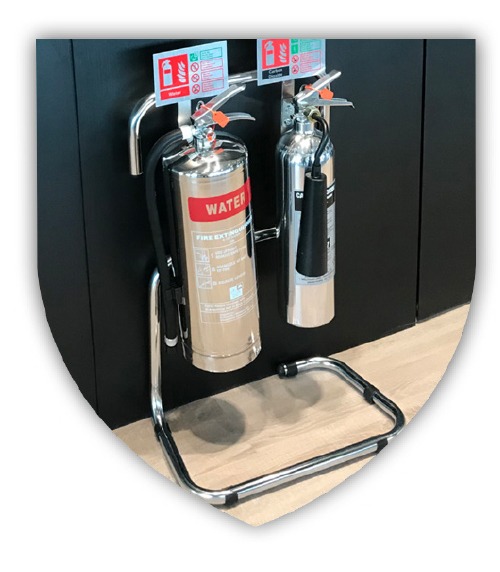
Polished stainless steel extinguishers are available in most extinguisher types such as C02, Water, Foam and Dry Powder. In addition to the aesthetics and design benefits over a traditional red extinguisher, they offer superior anti-corrosion resistance and durability benefits.

Stainless steel extinguishers
Mobile fire points

Mobile fire points

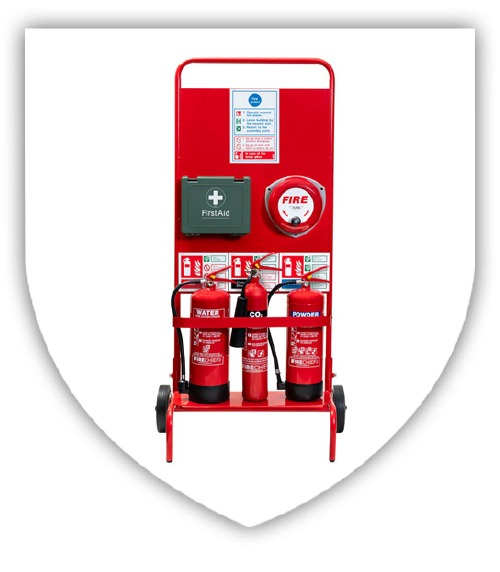
For environments like forecourts and construction sites, it isn’t always possible or practical to have fire extinguishers fixed to walls or limited to dedicated areas. This is where fire extinguisher trolleys and mobile fire points can help. They can have a manual hand bell and first aid kit with signage and accomodate two or three extinguisher types.

Extinguisher stands and signage

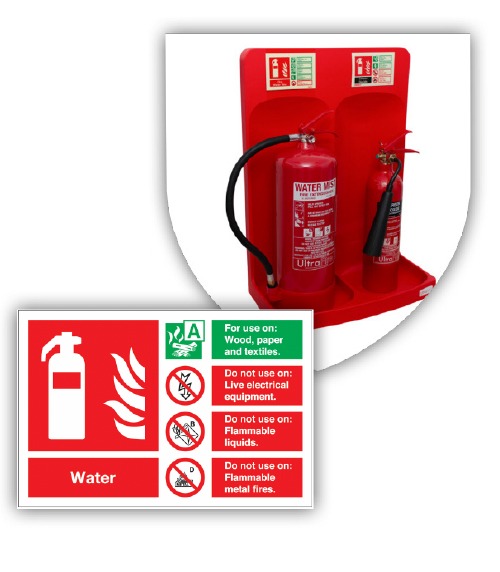
Available in single or double sizes, they are made from a single piece of durable plastic or metal wth a chrome finish, intended to provide a highly-visible location to store your extinguishers. Designed for indoor or outdoor use, they feature a high-grip finish for easy handling and a gripped base for stability. These tough stands easily stack together for storage and transportation with their minimalist and mostly flat design.

All installed extinguishers should be accompanied by a visible identification and usage sign. Fire Extinguisher Signs are crucial in an emergency.

See our separate Fire Safety Signage Guide

Extinguisher stands and signage
Fire extinguisher cabinets

Fire extinguisher cabinets

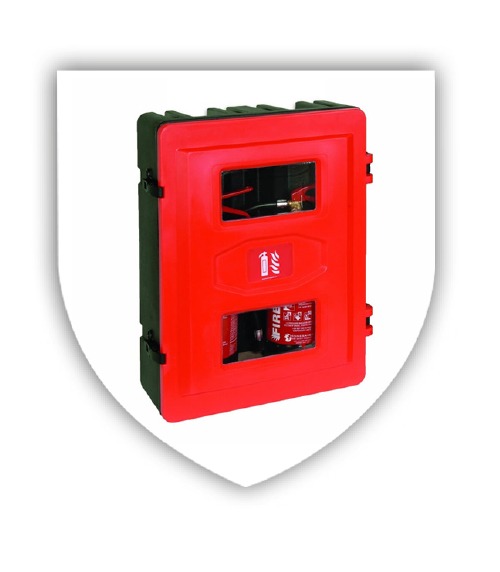
Prevent misuse, vandalism, and damage from adverse weather as well as for use on vehicles. Available in single or double sizes.

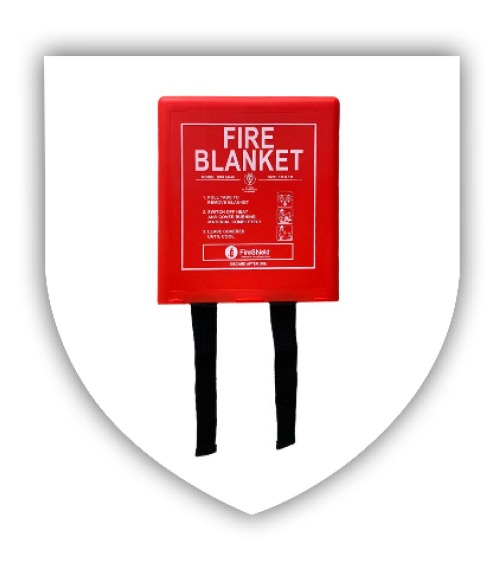
Fire blankets

A fire blanket is used to smother and extinguish small fires. By covering a small fire with your fire blanket, you can stop oxygen from feeding the fire – fires need heat, fuel and oxygen in order to burn and grow. Cutting off the oxygen supply with a fire blanket can be an easy way to stop a small fire from spreading. Fire blankets are typically used in food preparation areas and are most suitable for cooking fat and oil fires (class F), flammable liquids fires (class B) and fire fuelled by solid materials such as plastic, wood, paper, textiles and furniture (class A). For electrical fires and combustible metal fires (class D) do not use a fire blanket: instead, use a CO2 or dry powder extinguisher respectively.

Fire blankets
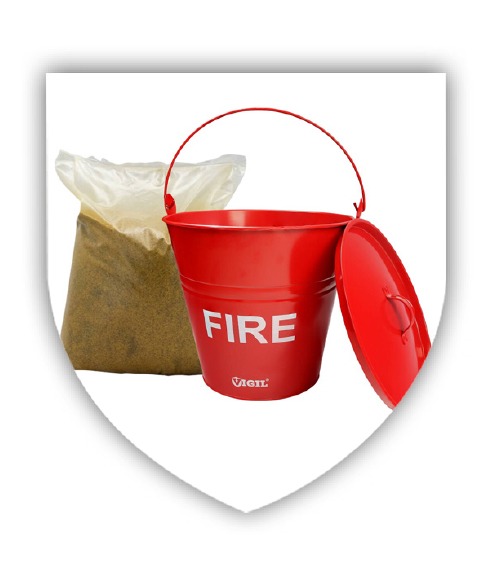
Fire buckets

Fire buckets

Fire buckets are an effective way to extinguish small, contained fires and contain spills of flammable liquids in the UK. They are typically filled with sand or water and are easy to use. They are a valuable tool for fire safety due to their simplicity (easy to refill), effectiveness, and affordability.

Fire Extinguisher Regulations

Fire extinguisher legislation in the UK can feel a little complicated for some people. That’s why we wrote this simplified guide to the UK’s current laws and available guidance on fire extinguishers.

As with all fire safety legislation in England and Wales, UK Fire Extinguisher regulations form part of ‘The Regulatory Reform (Fire Safety) Order 2005’, also known as the ‘RRO’.

All premises used for non-domestic purposes, with a few minor exceptions, come under this order.

You can read the The Regulatory Reform (Fire Safety) Order 2005 here

Whilst the legislation has been responsible for dramatically reducing commercial fires in the UK, it can be difficult to interpret if you’re not a fire safety professional – which is why we have answered some of the most frequently asked questions below as clearly and simply as possible.

Relevant British Standards

BS EN 3: The core standard for construction, testing, and approval of portable fire extinguishers. Ensures high quality and reliable fire fighting capability.

BS 5306-3:2017: Covers the commissioning and maintenance of portable fire extinguishers to ensure they remain safe and operational.

BS 5306-8:2023: Provides guidance on the selection and installation of portable fire extinguishers, including travel distance requirements.

BS 6165: Specifies requirements for small, disposable aerosol-type fire extinguishers

Extinguisher commissioning and servicing

Under the Regulatory Reform (Fire Safety) Order 2005 (RRO), all new fire extinguishers require a ‘Commissioning to Service’ as documented in BS 5306-3: 2017. This should be done by a qualified BAFE engineer.

Servicing should be carried out annually by a qualified BAFE registered engineer. Engineers will examine the overall condition of the extinguishers if the labelling is the pressure and weight, expiry dates and the pin and seal are adequate. A report will then be issued once the service has taken place to determine if they need replacement or not.

Extinguisher commissioning and servicing
RES Van
Our Fire Extinguisher Services

■ Fire Extinguisher Sales
■ Fire Extinguisher Servicing
■ Fire Extinguisher Refills
■ Fire Extinguisher Hire
■ Fire Extinguisher Accessories
■ Fire Safety Equipment
■ 24 Hour Call Outs


BAFE Registered

BAFE SP101 Service/Maintenance of Portable Fire Extinguishers: Third-party certificated by BSI.

BAFE Fire Safety Register – The trusted independent register of quality fire safety organisations for the UK since 1984

Protecting People and Property Since 1985

Download Fire Extinguisher Guide 2026

* The British Standards Institution has published BS ISO 3941:2026 – Classification of Fires. This introduces Class L for lithium-ion battery fires. However, this class has not yet been incorporated in the BS EN 2 / EN 3 extinguisher fire rating system. (April 2026)

Smoke Control Systems Guide 2026

SMOKE CONTROL SYSTEMS GUIDE 2026

This introductory smoke control systems guide covers the main types of systems, the standards and legislation that govern them, and the responsibilities of duty holders for installation, maintenance and compliance.

What is a smoke control system?

A smoke control system is a critical life-safety provision when installed in a UK building.

They are designed to protect the people inside buildings by maintaining escape routes, reducing smoke spread during a fire aiding safe evacuation and ensuring firefighting personnel can access the premises without suffering smoke related injuries or complications.

In many buildings, including blocks of flats and high-rise commercial premises, a smoke control system, integrated with a fire detection and alarm system to operate correctly in a fire scenario, is a legal requirement under the Building Regulations and related standards.

While a buildings height influences design, a smoke control system can be required in any building with enclosed escape routes where smoke would otherwise compromise safe egress.

Smoke Control Systems

Main types of smoke control and smoke ventilation systems

There two main types of smoke control and smoke ventilation systems, natural and mechanical.

Natural Smoke Ventilation Systems:

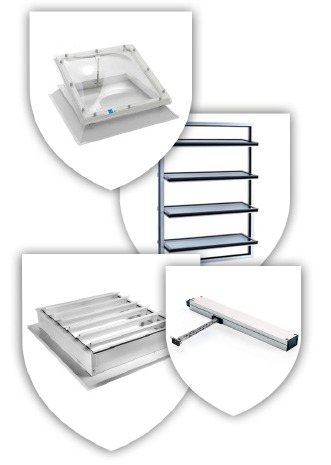
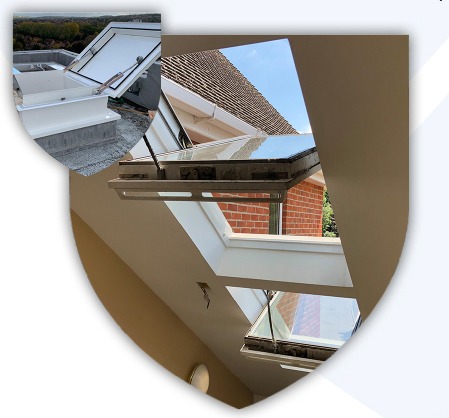
These systems rely on the natural buoyancy of hot smoke rising to exhaust it through strategic openings such as shaft doors, roof vents, windows or AOV louvres.

AOVs (Automatic Opening Vent)

AOVs (Automatic Opening Vent):
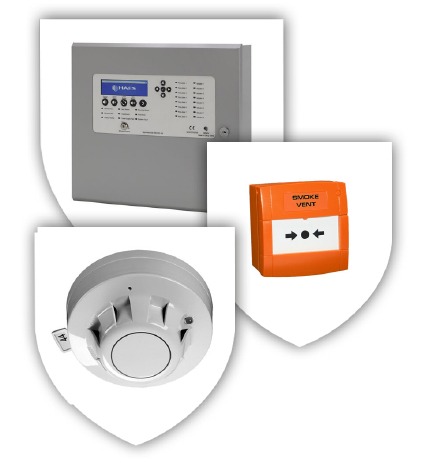
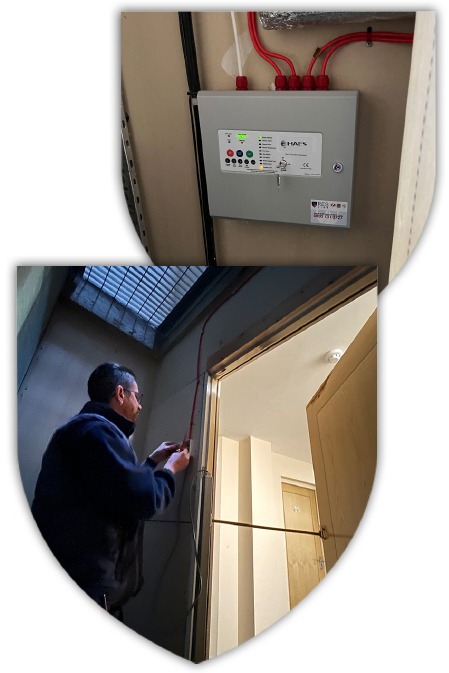
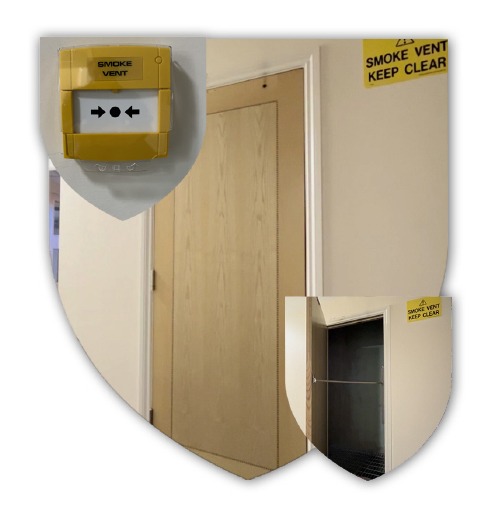
AOV’s are a commonly used type of natural smoke control system allowing smoke to rise and escape via a shaft door, window and or roof vents which are activated to open by either a smoke or heat detector (which is triggered by hot smoke’s innate buoyancy), or a manual smoke vent call point.

Smoke Shafts

Smoke Shafts:
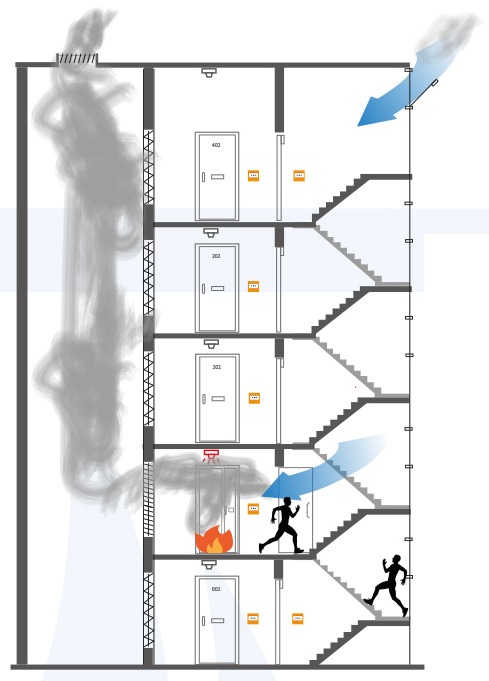
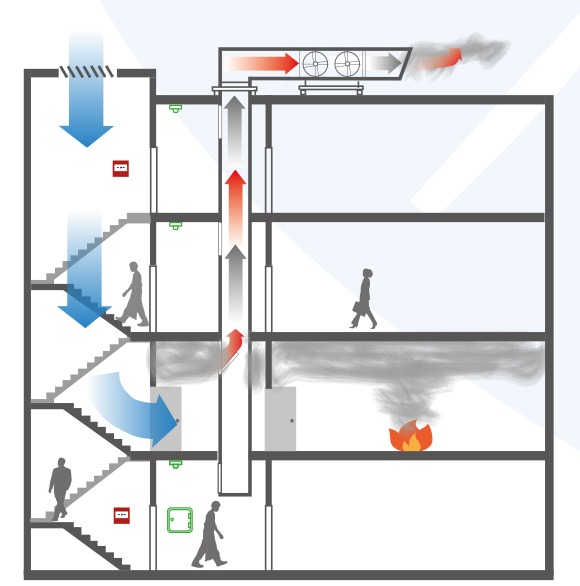
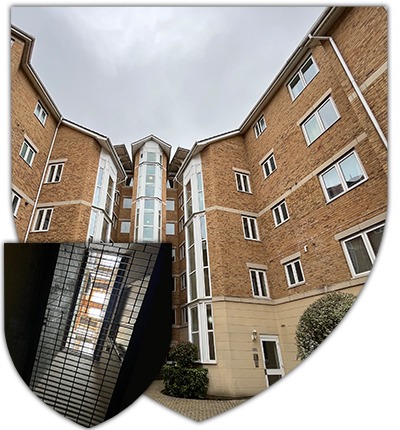
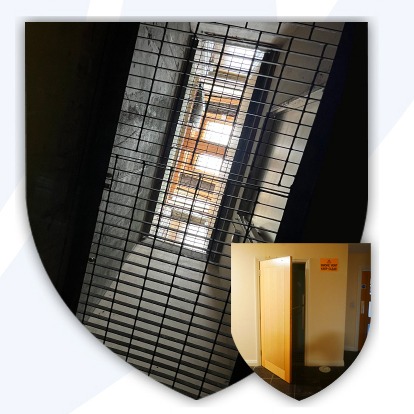
Smoke shafts are vertical ducts designed to serve multiple floors within a building, typically found in blocks of flats. Corridor vents connect to the shaft, allowing smoke to discharge safely to atmosphere at roof level. Smoke shafts are commonly used where extended corridors exceed the limits for simple natural ventilation and are frequently required under Approved Document B.

Natural Smoke Ventilation
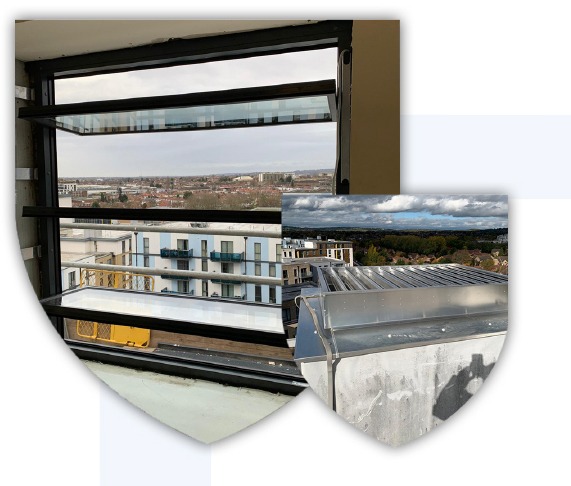
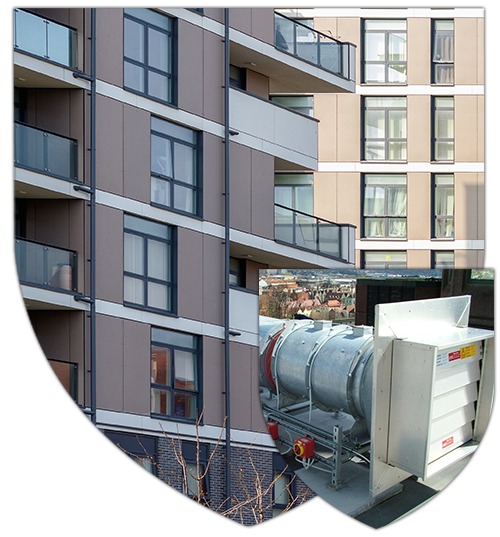
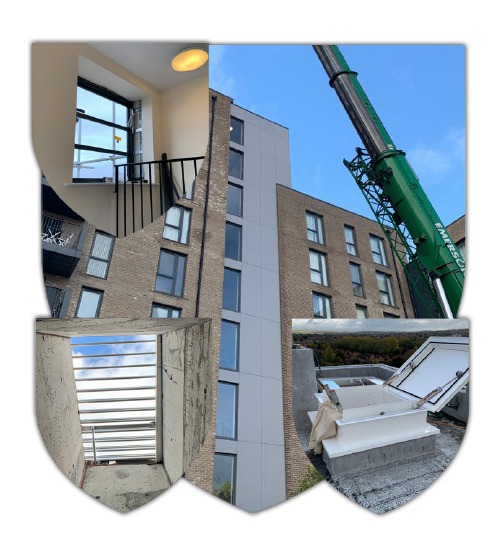
Typical example of natural smoke ventilation shaft and top of stairwell AOV

Typical example of natural smoke ventilation shaft and top of stairwell AOV

Mechanical Smoke Ventilation Systems:

These systems are used where natural ventilation is impractical, for example in many high-rise developments, taller, larger buildings and or those with more complex layouts.

Mechanical ventilation

Mechanical ventilation:
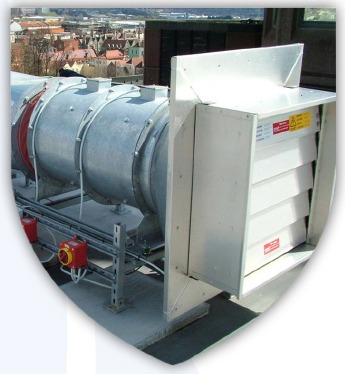
Mechanical ventilation systems use fans and controls to extract smoke from a building

Pressurisation systems

Pressurisation systems:
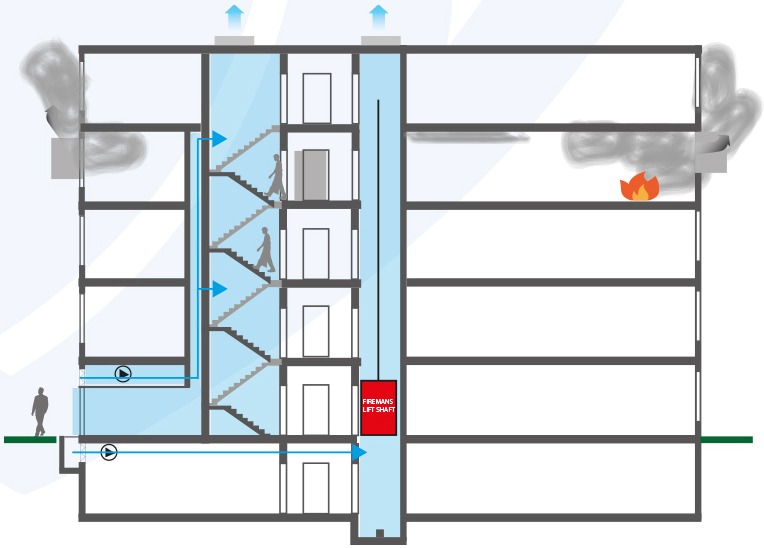
Pressurisation systems maintain higher air pressure in protected escape routes such as stairwells so that smoke is kept out. This is often a mechanical approach used in taller or larger complex buildings.

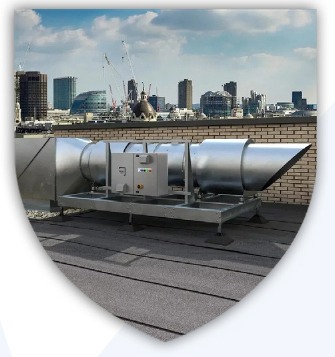
Typical example of mechanical ventilation

Typical example of mechanical ventilation

Typical example of a pressurisation system with staircase and firefighters’ lift shaft protection, and air release in the façade(s) (Source: BS EN 1201-13 2022)

Typical example of a pressurisation system with staircase and firefighters’ lift shaft protection, and air release in the façade(s) (Source: BS EN 1201-13 2022)

RRFSO

UK Smoke Control System requirements

Smoke control systems can form part of an overall fire strategy and must be integrated with the fire alarm and other life-safety systems. While the premises Fire Risk Assessment under the Regulatory Reform (Fire Safety) Order does not automatically mandate smoke control, it often identifies where smoke control is a proportionate life-safety measure, especially in multi-storey residential and high-risk buildings.

Residential Buildings:

Under Approved Document B, residential buildings over approximately 11 m (typically four storeys) normally require smoke control in common escape routes such as stairwells and corridors. This can be achieved with AOVs or equivalent smoke shafts providing the minimum free area required under Approved Document B (often 1.0m² in residential corridors, subject to design).

Guidance (such as BS 9991:2024) also influences how and where smoke control systems should be designed and can set specific performance criteria for tall residential blocks.

In many purpose-built blocks of flats designed around a stay-put strategy, smoke control systems are essential to maintaining tenable conditions in common corridors while individual flats remain compartmented.

In single-stair residential buildings, smoke control to corridors and stairwell cores is particularly critical, as the protected stairwell may be the sole means of escape for occupants above ground level.

High-Rise and Complex Buildings

High-Rise and Complex Buildings:

Buildings above certain height thresholds (e.g. over 30 m) generally need more engineered smoke control solutions, including mechanical smoke ventilation or pressurisation systems, especially when natural smoke ventilation alone cannot achieve the required performance.

Smoke Control Standards and Guidance in the UK

Smoke control systems must be designed by competent professionals, coordinated with fire strategy and fire detection systems, and installed in accordance with Approved Document B and relevant British Standards. Components must be certified and selected based on documented performance criteria.

AOV Engineer

Approved Document B – Building Regulations
Approved Document B sets out the performance requirements for fire safety in
buildings, including smoke control to protected escape routes. It guides where and
how smoke control measures should be applied in residential and other buildings.

BS EN 12101 Series
BS EN 12101 is a suite of standards (adopted in the UK) that governs the performance, testing
and certification of smoke control system components such as vents, fans, dampers and control panels. Compliance with these standards (and UKCA marking) is expected for any life-safety smoke control product.

BS 9991:2024 Fire safety in the design, use and management of residential buildings. Code of practice
BS 9991 provides best-practice guidance for smoke control and evacuation in residential buildings, and recent editions include updated provisions on when natural and mechanical smoke ventilation systems are required based on building height and travel distances.

BS 9999:2017 Fire safety in the design, use and management of buildings. Code of practice
BS 9999 supplements ADB and BS 9991 for non-residential, complex or bespoke buildings, offering additional guidance on smoke control design, inspection and testing requirements.

BS 7346-8:2013 Components for smoke control systems – Code of Practice for planning, design, installation, commissioning and maintenance
BS 7346-8 outlines the planning, design, installation, commissioning and maintenance of smoke control (including ventilation) systems.

AOV Case Study

Replacement AOV Case Study

View our project case study where we replaced a rooftop louvre vent, installed louvre windows and serviced AOV domes.

View Case Study

Compliance

Smoke control systems are a vital aspect of fire safety and must be correctly specified, designed, installed, commissioned and maintained by competent professionals to ensure the system delivers when required.

A compliant smoke control and ventilation system can reduce the risk of a fire developing and limit smoke damage to a building and greatly reduces the chances of building occupants choking or being overwhelmed by smoke. It reduces the risk of smoke inhalation around escape routes such as corridors and staircases and makes it easier for emergency services to access a building.

AOV Devices

Specification: A correctly specified smoke control system is a core part of a buildings fire strategy design and therefore specification typically rests with a fire safety specialist (competent person), such as fire engineers, fire risk assessors by way of the premises Fire Risk Assessment or Enforcing Authorities.

Design: The design of a smoke control system, depending on the specification, typically rests with specialist system manufacturers and installers depending on the type and complexity of the system required.

Installation: The installation of a smoke control system may take place over several phases of a buildings construction; therefore, all those involved should be competent persons / companies with a specialist system installer overseeing the installation.

Commissioning: New systems should be commissioned and tested to prove correct operation, with all cause and effects clearly documented showing how components operate in response to a fire.

Maintenance: Regular inspection and testing of AOVs, control panels, actuators, fans and associated equipment is essential to ensure smoke control systems are reliable when needed. Refer to the premises fire risk assessment and or a specialist service and maintenance provider as to the frequency of regular inspections.

BS7346:8 Mandates a minimum of two service visits per year by qualified engineers, including special inspections* during the changeover of maintenance providers.

AOV Devices
smoke control

Record keeping: Detailed records of all maintenance regimes, including daily or weekly tests, quarterly visual inspections and six-monthly / annual servicing and maintenance by competent engineers.

*BS7346:8 Components for Smoke Control Systems: Code of Practice for design installation, commissioning and maintenance recommends that special inspections of smoke vent systems are completed when a new contractor takes over maintenance. This will also be required as part of a building safety case for submission to the Building Safety Regulator under the Building Safety Act.

The frequent lack of sufficient documentation available on site can make it difficult to ascertain the original design intent for systems, particularly fire engineered solutions that do not follow the approved guidance. In such cases an assessment must be made using fire engineering to arrive at appropriate performance criteria that can be tested to on site. Unless clear performance requirements are available then any regular testing and maintenance will be inadequate and inconclusive.

Failure to maintain smoke control systems may result in enforcement action by an Enforcing Authority such as the Fire and Rescue Authority.

RES AOV

Smoke control and ventilation systems with RES Fire & Security

At RES Fire & Security, our experienced service engineers can regularly inspect and test as well as service and maintain smoke control and ventilation systems six-monthly / annually to the requirements of both the system and premises. For premises with fire detection and alarm systems with complex ventilation systems our engineers work with specialist system manufacturers/maintenance providers.

We can also design, install and commission smoke control and ventilation systems based on the specification provided for your premises, working with specialist system manufacturers to ensure installations comply with current legislation and UK Building Regulations. Our experienced and highly trained installers ensure that your smoke control and ventilation system is installed correctly, thoroughly tested and handed over on time.

RES Fire & Security offer smoke control and ventilation systems services covering the South of England including London, Berkshire, Bracknell, Windsor, Middlesex & Surrey, Oxfordshire, Hampshire, Buckinghamshire, Hertfordshire, Essex & Kent, West & East Sussex, Reading, Maidenhead, Slough, Newbury and the surrounding areas.

AOV Case Study

Case Study: Smoke control and ventilation routine service and repair

View our project case study where we carried out a routine service on the aov system and subsequently carried out a repair.

View Case Study

RES AOV Services
Our Smoke Control & Ventilation System Services

■ Servicing and maintenance
■ Regular checks, tests
■ Repair and/or upgrading of existing systems
■ Design and installation

Protecting People and Property Since 1985

Download The Smoke Control Systems Guide

Fire safety signage guide 2026

FIRE SAFETY SIGNAGE GUIDE 2026

Fire safety signs are designed to warn building occupants of any fire hazards, provide information on fire safety equipment and procedures, and give concise instructions about the actions to take in the event of a fire.

They are an integral part of a buildings fire safety measures, helping to ensure that all occupants exit the premises as safely and as quickly as possible as well as aiding attending emergency services. Installing and maintaining the correct fire safety signage in a premises is not only essential to saving lives and protecting property but is also a legal requirement

UK Regulations

The Health and Safety (Safety Signs and Signals) Regulations 1996 (HSR) outlines
the types of fire signs, their placement, and the importance of maintenance.

The Regulatory Reform (Fire Safety) Order 2005 (RRO) requires a premises Responsible
Person(s) to take responsibility for fire safety ensuring that the premises Fire Risk Assessment
(FRA) covers all fire safety signage requirements.

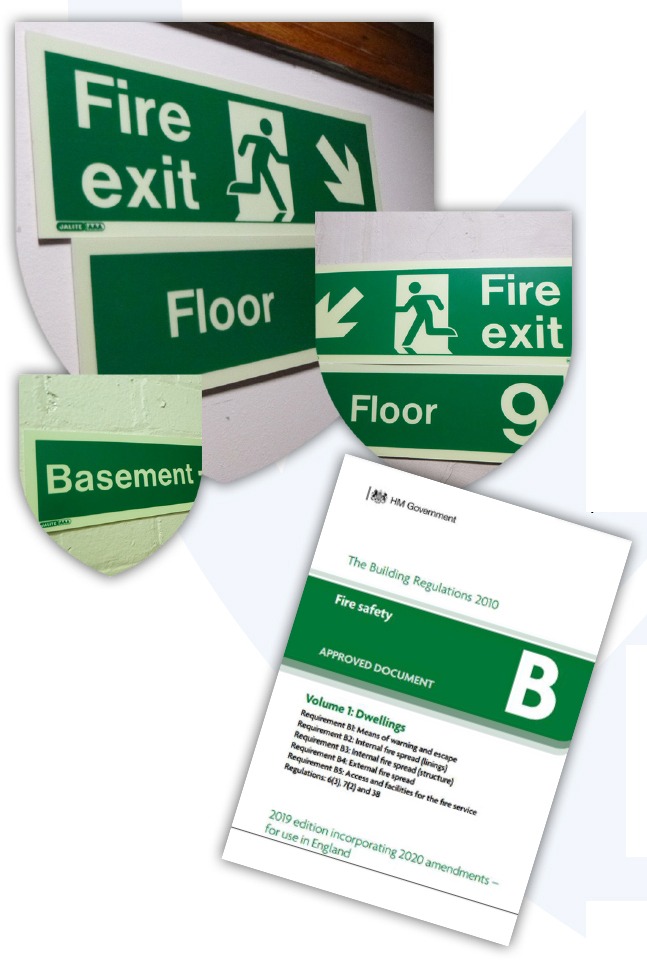
The Fire Safety (England) Regulations 2022 which came into effect in England from 23 January 2023 made it a legal requirement for wayfinding signs to be installed in all high-rise residential buildings in England, including clear markings identifying floor and individual flat numbers to assist the Fire and Rescue Service.

Signage Guide

The main British Standards governing fire safety signs in the UK are:

British Standards

The main British Standards governing fire safety signs in the UK are:

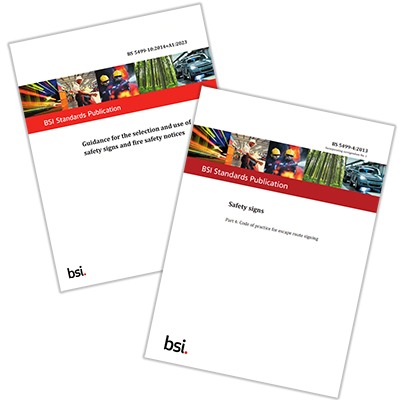
BS 5499-10:2014+A1:2023 Guidance for the selection and use of safety signs and fire safety notices, which provides guidance on how to select, install, position and maintain safety signs conforming to BS ISO 3864 1 and BS EN ISO 7010.

BS 5499-4:2013 Safety signs – Code of practice for escape route signing, which gives recommendations for the selection and use of escape route signs conforming to BS EN ISO 7010 to be provided within buildings.

BS 5499 satisfies the requirements of the HSR and the RRO and is applicable to all premises, except for private domestic premises. However, it is applicable to the common access areas within multi occupied dwellings.

What signs does a premise require?

There are several categories and types of fire safety signage a premises requires.

Carrying out an FRA and regularly reviewing it, as required by the RRO, is essential to determine which signs your premises requires and are always maintained, keeping your premises compliant at all times.

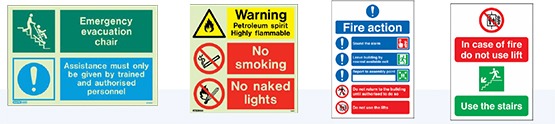
■ Fire exit and Exit signs highlight the safest evacuation route and nearest emergency exit of a building.

■ Fire door signs provide mandatory instructions to occupants to ensure the effectiveness of a building’s compartmentation.

■ Fire alarm signs highlight the nearest fire alarm and manual fire alarm call points, providing information regarding its activation.

■ Emergency door operation signs offer simple instructions on how to operate emergency exit doors.

■ Stairway and floor level identification (wayfinding) signs enable occupants of multi-storey high-rise buildings to accurately and quickly inform Fire and Rescue Services of the location of a fire and assist firefighters in navigating their way around the building.

■ Fire assembly point signs show where a building’s assembly point is located to enable evacuees to report to their designated point and identify any missing persons quickly.

■ Fire extinguisher signs indicate the position and type of extinguishers present in a premises, show the classes of fire they can be used on and how to operate them safely, and help identify any missing extinguishers that need replacing.

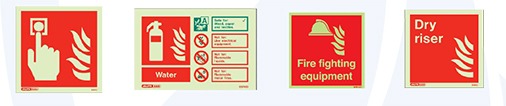
■ Fire equipment signs ensure that equipment is present, and correctly and clearly identified (where provided) to enable firefighters to gain immediate access to facilities such as rising main outlets and smoke control vents on arrival at the scene of a fire.

■ Fire action notice signs include step-by-step instructions for occupants to follow in the event of a fire.

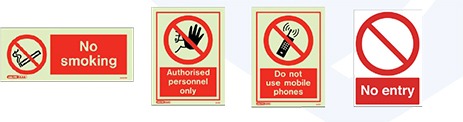
■ Prohibition Signs indicate actions or behaviours that are strictly forbidden because they pose a health or fire safety risk.

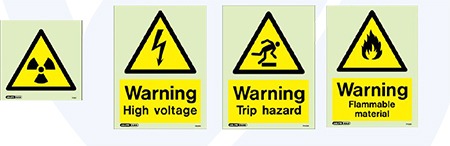
■ Warning and Hazard signs identify the location of potential hazardous materials or environments.

■ Fire safety notices and Fire plans reinforce important messages of life safety arrangements to occupants and Fire and Rescue Services concerning the premises.


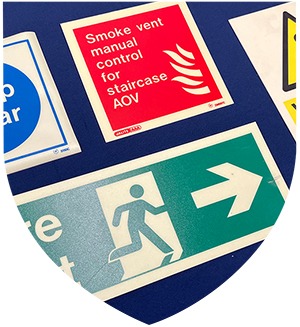
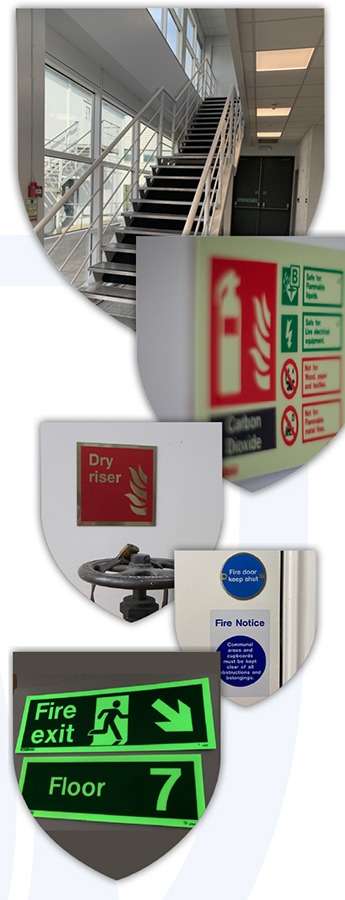
signage montage
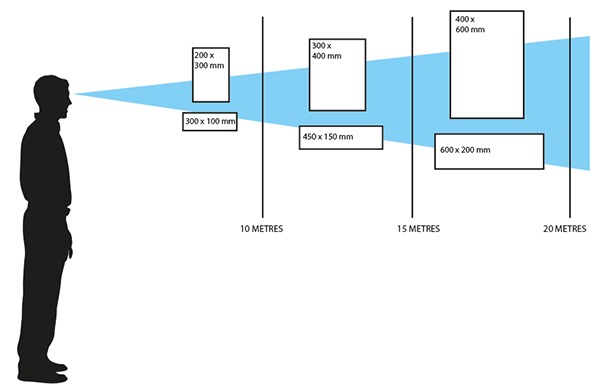
signage diagram

It’s important to remember that in the event of a fire, smoke and power outages can reduce sign visibility. That’s why it is always worth considering photoluminescent signs which function without the need for any additional illumination to help maintain their visibility.

Another important consideration is the size of signs, especially when it comes to safe condition signs such as Fire exit and Exit signs.

Viewing distances are calculated based on sign height and illumination type, which typically are 200x sign height for internal illumination and 100x for external illumination.

Generally,
300mm x 100mm signs work for up to 10m,
450mm x150mm: up to 15m,
600mm x 200mm: up to 20m,
and 900mm x 300mm: over 47m distances.

Signage manufacturers such as JALITE provide detailed guides on viewing distances and the size selection of their signage range to ensure premises compliance.
https://www.jalite-group.com/en/content/solutions

Sign Categories

Fire safety signage is categorised by colour and shape to indicate safety information, hazards, and actions under UK Regulations. The five main categories are Safe Condition (green), Mandatory (blue), Fire Equipment (red), Warning (yellow)), and Prohibition (red) signs. They ensure safe evacuation and fire safety compliance.

Safe Condition Signs are green rectangular or square signs which mark Exits, Fire Exits, Escape routes, operation of doors on escape routes and exits, Assembly points and the location of safety equipment, such as first aid equipment and breathing apparatus.

Safe Condition Signs

Mandatory Fire Safety Signs and Notices have blue circles which must be obeyed as a legal requirement such as fire door signs, fire action notices and keeping escape routes clear.

Mandatory Fire Safety Signs

Fire Equipment Signs are red signs to indicate the location of fire safety equipment such as fire extinguishers, fire alarm call points and fire brigade equipment.

Fire Equipment Signs

Warning Signs are yellow triangular signs and warn of potential risks such as flammable liquids, gas and chemicals.

Warning Signs

Prohibition Signs are red circular signs with crossbars that forbid certain actions that could be dangerous such as No Smoking, Do not use mobile phones and No Admittance.

Prohibition Signs

A premises may well have Combination Signs, one sign providing different instructions using each signage categories colour such as Green for a safe condition/escape route action, Blue for a mandatory action, Red to identify fire equipment or a prohibition action, and Yellow to warn people to a danger or an unsafe action.

Combination Signs

Above: Typical examples of combination signs found in premises.

Orange signs indicate serious hazards, often related to dangerous substances that may intensify or complicate a fire. Examples include, highly flammable liquids, reactive chemicals and explosive materials. Orange acts as an enhanced visual warning in environments where extreme caution is required.

serious hazards

Above: Typical examples of combination signs found in premises.

Wayfinding signage

Wayfinding signage

The Fire Safety (England) Regulations 2022 made it a legal requirement from 23 January 2023 for all high-rise residential buildings in England to install Wayfinding Signage. This includes clear markings identifying floor and individual flat numbers as per the requirements of Building Regulations:

Wayfinding signage for the fire service 15.13 To assist the fire service to identify each floor in a block of flats with a top storey more than 11m above ground level, floor identification signs and flat indicator signs should be provided. (Building Regulations 2010 AD B V1 B5 Section 15: Access to buildings for firefighting personnel – flats)

Approved Document B should be consulted for detailed guidance on the type, positioning and specification for signs; the wording to be used on each floor identification sign; and the specification for flat indicator signs to provide information relating to flats accessed on each storey.

Further information:

Fact sheet: Wayfinding signage (regulation 8)

Case Study – Wayfinding signage for high rise residential buildings

Fire alarm zone plan

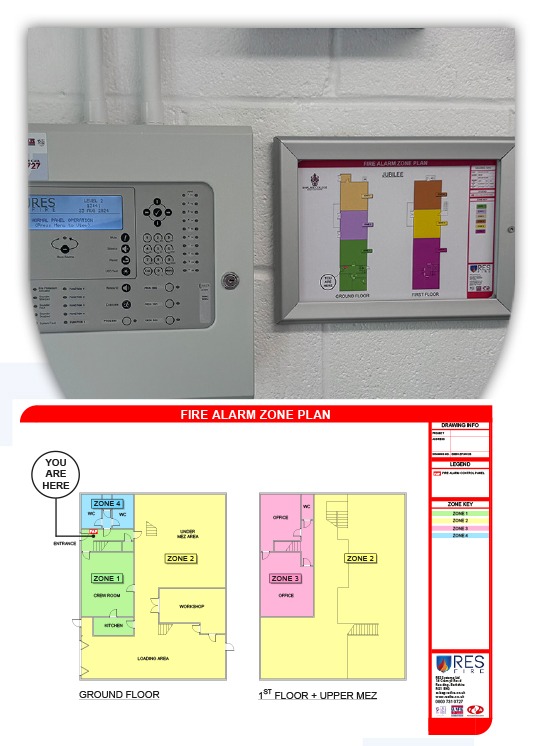
A fire alarm zone plan is a diagram showing how a building is divided into fire detection zones and is typically located next to the fire alarm control panel. It should include important features such as entrances, exits and circulation areas (fire doors) and should be oriented to match the viewers perspective and be presented in a tamper proof frame.

When a fire alarm activates, anyone responding to the alarm needs to be able to identify the affected area immediately. The plan can be used for quickly locating the area the alarm has been activated in as well as for fire marshals when evacuating the building.
This improves response times, supports effective evacuation, and enables fire and rescue services to act quickly.

If your premises does not have an accurate and up-to-date fire zone plan this is now classified as a major non-conformity according to BS 5839- 1: 2025.

See our Fire alarm zone plan video

Zone plan

Fire evacuation plans

Fire evacuation plans

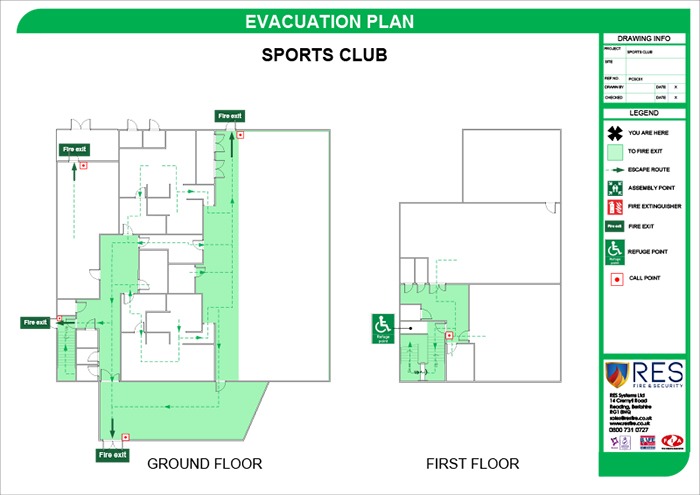
Fire Evacuation Plans are an integral feature of your buildings system of safety signs and play a vital role in your fire safety strategy. Fire Evacuation and Procedure Plans are created to suit the fire safety strategy of your building.

Your plans must show how you have:
■ a clear passageway to all escape routes
■ clearly marked escape routes that are as short and direct as possible
■ enough exits and routes for all people to escape
■ emergency doors that open easily
■ emergency lighting where needed
■ training for all employees to know and use the escape routes
■ a safe meeting point for staff
■ disabled facilities such as refuges and evacuation chairs

People with mobility needs should have special arrangements for people with mobility needs, for example make sure there are people to help wheelchair users get downstairs if there’s a fire.

For further information see our Evacuation Guide

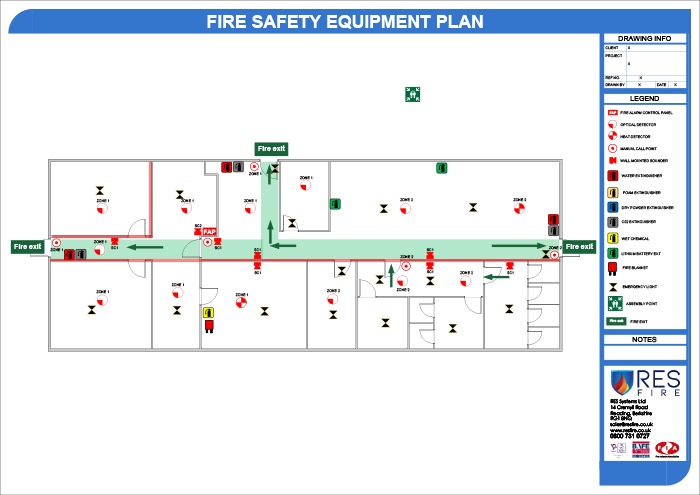
Fire equipment plans

Fire equipment plans are visual, documented layouts of a building that identify the precise locations of fire safety systems, measures, and fire-fighting equipment. They are crucial for complying with Building Regulations, RRO, assisting emergency services, and guiding regular checks, servicing and maintenance.

Key Components of a Fire Equipment Plan:
■ Locations of Active Equipment: Clearly marking the locations of fire extinguishers, fire blankets, and sprinkler systems.
■ Detection & Alarm Systems: Identifying fire alarm panels, call points, smoke detectors, and sounders.
■ Evacuation Routes: Displaying designated emergency exits, emergency doors, illuminated fire exit signs, and emergency escape lighting.
■ Building Information: Marking fire-rated doors, walls, and escape routes to show compartmentation designed to restrict fire spread.
■ Emergency Service Access: Indicating dry/wet rising mains, firefighting lifts, and the building information box (premises (secure) information box).

Fire equipment and evacuation plans should be used during staff induction training to ensure staff know the locations of extinguishers and escape routes. Also, they should be readily available for the Fire and Rescue service to locate firefighting equipment as well as any Hazards present on site and identifying the building layout upon arrival.

Fire equipment plans

General advice concerning ‘Fire Plans’

Fire strategy plans are essential for modern premises to have on record, often contained within the premises fire strategy document, they should be used by an assessor during the FRA process to ensure all fire safety systems and measures, including fire safety signs are maintained as originally designed as an absolute minimum.

In older premises where there is no record of the original ‘fire’ plans, by using basic floor plans, a competent person such as a fire risk assessor should use floor plans as part of the FRA process to record and make recommendations regarding the premises fire safety systems, equipment, signage and passive fire protection measures. One recommendation may be to include a full compartmentation survey complete with plan should confirmation of the premises internal fire resistance be required and or there are concerns with the lack of fire resistance in some areas.

‘Fire Plans’ for any premises under the RRO are an essential item for a premise fire safety document records and should be kept on site to ensure any works (decoration, renovation or maintenance) being carried out, the plan is referred to so fire safety systems, equipment, signage and passive fire protection measures are always maintained and not compromised.

Effective fire safety signing system

Safety signs are a requirement to protect the health and safety of the employees and anyone within the vicinity of the building. For an effective safety signing system, signs should be of similar style, design and format. A good way to achieve this, is to ensure that your signs conform to standards.

Why choose JALITE AAA photoluminescent signs and products?

Legislation states that all safety signs require illumination and must remain illuminated under a power loss. This requirement can be met by using JALITE AAA photoluminescent signs.

RES are an Authorised Distributor of the JALITE range of photoluminescent safety products which now include fire safety signs, health and safety signs, safety way guidance systems and even photoluminescent paint.

JALITE Authorised Distributor
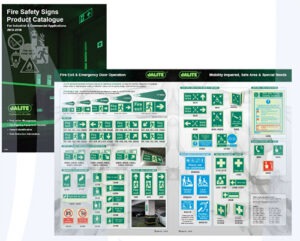
JALITE FIRE SAFETY SIGNS PRODUCT CATALOGUE
RES Van

Our Fire Safety Signage Services

■ Fire Safety Signage Sales
■ Fire Safety Signage Installation
■ Fire Safety Signage Guidance, Advice & Training

> More Information

Our Fire Plan Services

■ Fire Alarm Zone Plans
■ Fire Equipment Plans
■ Fire Escape Plans
■ Fire Evacuation and Procedure Plans

> More Information

Protecting People and Property Since 1985

Download this Fire Safety Signage Guide