
FIRE SAFETY SIGNAGE GUIDE 2026
Fire safety signs are designed to warn building occupants of any fire hazards, provide information on fire safety equipment and procedures, and give concise instructions about the actions to take in the event of a fire.
They are an integral part of a buildings fire safety measures, helping to ensure that all occupants exit the premises as safely and as quickly as possible as well as aiding attending emergency services. Installing and maintaining the correct fire safety signage in a premises is not only essential to saving lives and protecting property but is also a legal requirement
UK Regulations
The Health and Safety (Safety Signs and Signals) Regulations 1996 (HSR) outlines
the types of fire signs, their placement, and the importance of maintenance.
The Regulatory Reform (Fire Safety) Order 2005 (RRO) requires a premises Responsible
Person(s) to take responsibility for fire safety ensuring that the premises Fire Risk Assessment
(FRA) covers all fire safety signage requirements.
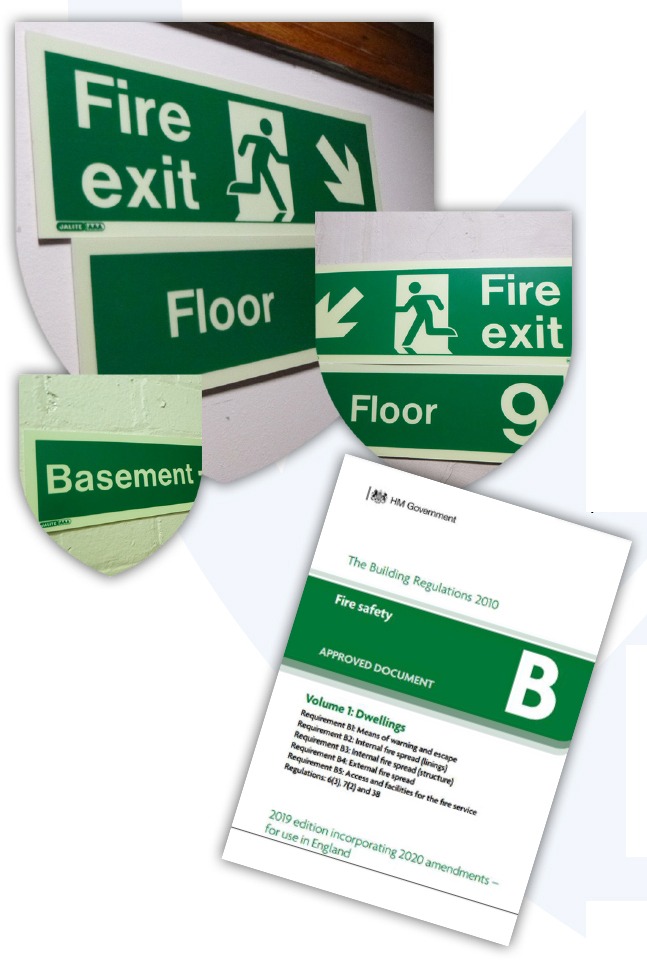
The Fire Safety (England) Regulations 2022 which came into effect in England from 23 January 2023 made it a legal requirement for wayfinding signs to be installed in all high-rise residential buildings in England, including clear markings identifying floor and individual flat numbers to assist the Fire and Rescue Service.
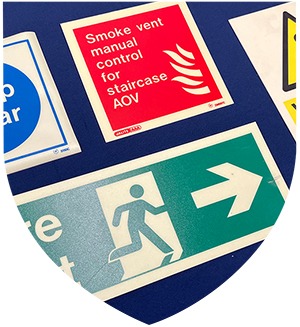
The main British Standards governing fire safety signs in the UK are:

The main British Standards governing fire safety signs in the UK are:
BS 5499-10:2014+A1:2023 Guidance for the selection and use of safety signs and fire safety notices, which provides guidance on how to select, install, position and maintain safety signs conforming to BS ISO 3864 1 and BS EN ISO 7010.
BS 5499-4:2013 Safety signs – Code of practice for escape route signing, which gives recommendations for the selection and use of escape route signs conforming to BS EN ISO 7010 to be provided within buildings.
BS 5499 satisfies the requirements of the HSR and the RRO and is applicable to all premises, except for private domestic premises. However, it is applicable to the common access areas within multi occupied dwellings.
What signs does a premise require?
There are several categories and types of fire safety signage a premises requires.
Carrying out an FRA and regularly reviewing it, as required by the RRO, is essential to determine which signs your premises requires and are always maintained, keeping your premises compliant at all times.
■ Fire exit and Exit signs highlight the safest evacuation route and nearest emergency exit of a building.
■ Fire door signs provide mandatory instructions to occupants to ensure the effectiveness of a building’s compartmentation.
■ Fire alarm signs highlight the nearest fire alarm and manual fire alarm call points, providing information regarding its activation.
■ Emergency door operation signs offer simple instructions on how to operate emergency exit doors.
■ Stairway and floor level identification (wayfinding) signs enable occupants of multi-storey high-rise buildings to accurately and quickly inform Fire and Rescue Services of the location of a fire and assist firefighters in navigating their way around the building.
■ Fire assembly point signs show where a building’s assembly point is located to enable evacuees to report to their designated point and identify any missing persons quickly.
■ Fire extinguisher signs indicate the position and type of extinguishers present in a premises, show the classes of fire they can be used on and how to operate them safely, and help identify any missing extinguishers that need replacing.
■ Fire equipment signs ensure that equipment is present, and correctly and clearly identified (where provided) to enable firefighters to gain immediate access to facilities such as rising main outlets and smoke control vents on arrival at the scene of a fire.
■ Fire action notice signs include step-by-step instructions for occupants to follow in the event of a fire.
■ Prohibition Signs indicate actions or behaviours that are strictly forbidden because they pose a health or fire safety risk.
■ Warning and Hazard signs identify the location of potential hazardous materials or environments.
■ Fire safety notices and Fire plans reinforce important messages of life safety arrangements to occupants and Fire and Rescue Services concerning the premises.
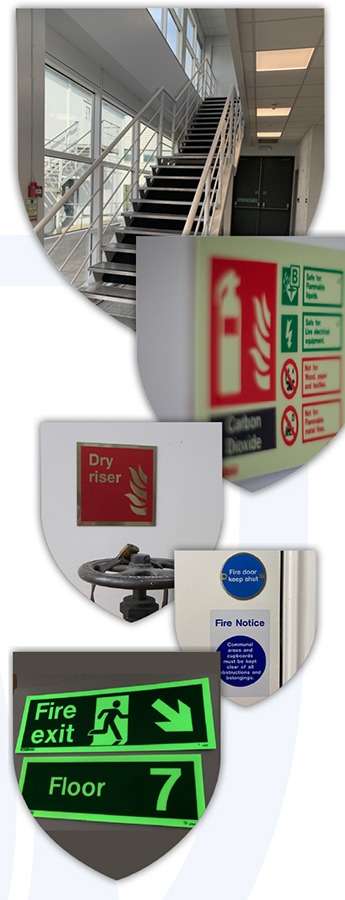
It’s important to remember that in the event of a fire, smoke and power outages can reduce sign visibility. That’s why it is always worth considering photoluminescent signs which function without the need for any additional illumination to help maintain their visibility.
Another important consideration is the size of signs, especially when it comes to safe condition signs such as Fire exit and Exit signs.
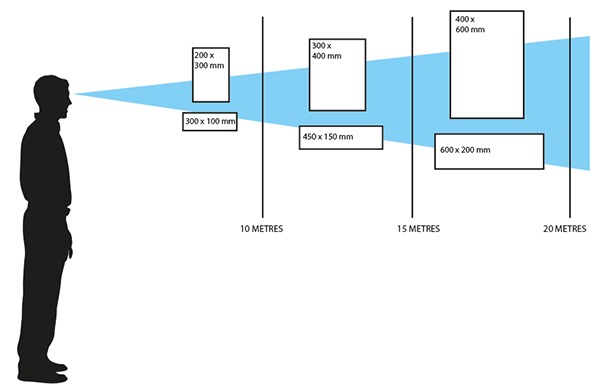
Viewing distances are calculated based on sign height and illumination type, which typically are 200x sign height for internal illumination and 100x for external illumination.
Generally,
300mm x 100mm signs work for up to 10m,
450mm x150mm: up to 15m,
600mm x 200mm: up to 20m,
and 900mm x 300mm: over 47m distances.
Signage manufacturers such as JALITE provide detailed guides on viewing distances and the size selection of their signage range to ensure premises compliance.
https://www.jalite-group.com/en/content/solutions
Sign Categories
Fire safety signage is categorised by colour and shape to indicate safety information, hazards, and actions under UK Regulations. The five main categories are Safe Condition (green), Mandatory (blue), Fire Equipment (red), Warning (yellow)), and Prohibition (red) signs. They ensure safe evacuation and fire safety compliance.
Safe Condition Signs are green rectangular or square signs which mark Exits, Fire Exits, Escape routes, operation of doors on escape routes and exits, Assembly points and the location of safety equipment, such as first aid equipment and breathing apparatus.

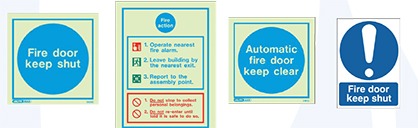
Mandatory Fire Safety Signs and Notices have blue circles which must be obeyed as a legal requirement such as fire door signs, fire action notices and keeping escape routes clear.
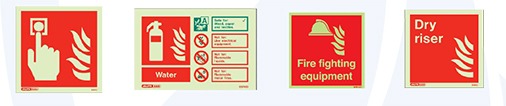
Fire Equipment Signs are red signs to indicate the location of fire safety equipment such as fire extinguishers, fire alarm call points and fire brigade equipment.
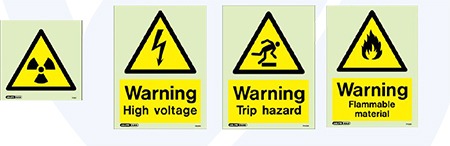
Warning Signs are yellow triangular signs and warn of potential risks such as flammable liquids, gas and chemicals.
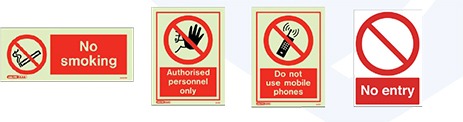
Prohibition Signs are red circular signs with crossbars that forbid certain actions that could be dangerous such as No Smoking, Do not use mobile phones and No Admittance.
A premises may well have Combination Signs, one sign providing different instructions using each signage categories colour such as Green for a safe condition/escape route action, Blue for a mandatory action, Red to identify fire equipment or a prohibition action, and Yellow to warn people to a danger or an unsafe action.
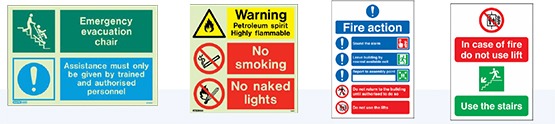
Above: Typical examples of combination signs found in premises.
Orange signs indicate serious hazards, often related to dangerous substances that may intensify or complicate a fire. Examples include, highly flammable liquids, reactive chemicals and explosive materials. Orange acts as an enhanced visual warning in environments where extreme caution is required.

Above: Typical examples of combination signs found in premises.
Wayfinding signage
The Fire Safety (England) Regulations 2022 made it a legal requirement from 23 January 2023 for all high-rise residential buildings in England to install Wayfinding Signage. This includes clear markings identifying floor and individual flat numbers as per the requirements of Building Regulations:
Wayfinding signage for the fire service 15.13 To assist the fire service to identify each floor in a block of flats with a top storey more than 11m above ground level, floor identification signs and flat indicator signs should be provided. (Building Regulations 2010 AD B V1 B5 Section 15: Access to buildings for firefighting personnel – flats)
Approved Document B should be consulted for detailed guidance on the type, positioning and specification for signs; the wording to be used on each floor identification sign; and the specification for flat indicator signs to provide information relating to flats accessed on each storey.
Further information:
Fact sheet: Wayfinding signage (regulation 8)
Case Study – Wayfinding signage for high rise residential buildings
Fire alarm zone plan
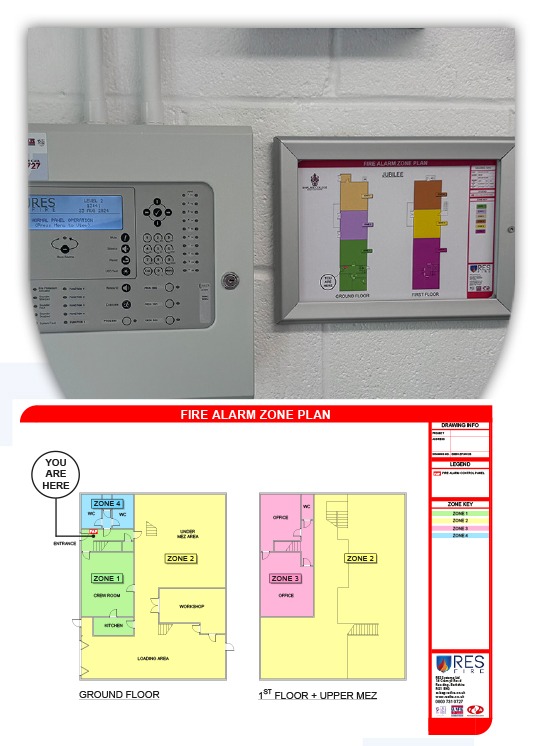
A fire alarm zone plan is a diagram showing how a building is divided into fire detection zones and is typically located next to the fire alarm control panel. It should include important features such as entrances, exits and circulation areas (fire doors) and should be oriented to match the viewers perspective and be presented in a tamper proof frame.
When a fire alarm activates, anyone responding to the alarm needs to be able to identify the affected area immediately. The plan can be used for quickly locating the area the alarm has been activated in as well as for fire marshals when evacuating the building.
This improves response times, supports effective evacuation, and enables fire and rescue services to act quickly.
If your premises does not have an accurate and up-to-date fire zone plan this is now classified as a major non-conformity according to BS 5839- 1: 2025.
Fire evacuation plans
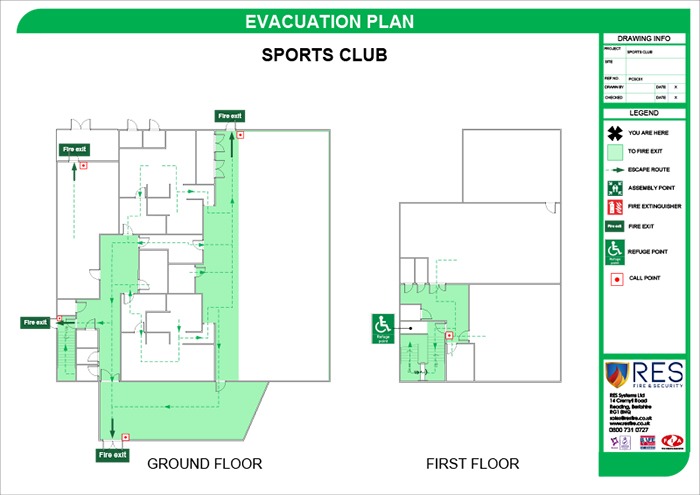
Fire Evacuation Plans are an integral feature of your buildings system of safety signs and play a vital role in your fire safety strategy. Fire Evacuation and Procedure Plans are created to suit the fire safety strategy of your building.
Your plans must show how you have:
■ a clear passageway to all escape routes
■ clearly marked escape routes that are as short and direct as possible
■ enough exits and routes for all people to escape
■ emergency doors that open easily
■ emergency lighting where needed
■ training for all employees to know and use the escape routes
■ a safe meeting point for staff
■ disabled facilities such as refuges and evacuation chairs
People with mobility needs should have special arrangements for people with mobility needs, for example make sure there are people to help wheelchair users get downstairs if there’s a fire.
For further information see our Evacuation Guide
Fire equipment plans
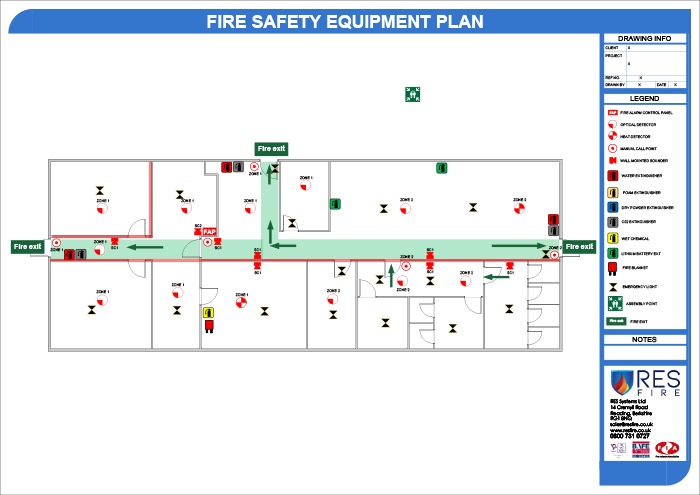
Fire equipment plans are visual, documented layouts of a building that identify the precise locations of fire safety systems, measures, and fire-fighting equipment. They are crucial for complying with Building Regulations, RRO, assisting emergency services, and guiding regular checks, servicing and maintenance.
Key Components of a Fire Equipment Plan:
■ Locations of Active Equipment: Clearly marking the locations of fire extinguishers, fire blankets, and sprinkler systems.
■ Detection & Alarm Systems: Identifying fire alarm panels, call points, smoke detectors, and sounders.
■ Evacuation Routes: Displaying designated emergency exits, emergency doors, illuminated fire exit signs, and emergency escape lighting.
■ Building Information: Marking fire-rated doors, walls, and escape routes to show compartmentation designed to restrict fire spread.
■ Emergency Service Access: Indicating dry/wet rising mains, firefighting lifts, and the building information box (premises (secure) information box).
Fire equipment and evacuation plans should be used during staff induction training to ensure staff know the locations of extinguishers and escape routes. Also, they should be readily available for the Fire and Rescue service to locate firefighting equipment as well as any Hazards present on site and identifying the building layout upon arrival.
General advice concerning ‘Fire Plans’
Fire strategy plans are essential for modern premises to have on record, often contained within the premises fire strategy document, they should be used by an assessor during the FRA process to ensure all fire safety systems and measures, including fire safety signs are maintained as originally designed as an absolute minimum.
In older premises where there is no record of the original ‘fire’ plans, by using basic floor plans, a competent person such as a fire risk assessor should use floor plans as part of the FRA process to record and make recommendations regarding the premises fire safety systems, equipment, signage and passive fire protection measures. One recommendation may be to include a full compartmentation survey complete with plan should confirmation of the premises internal fire resistance be required and or there are concerns with the lack of fire resistance in some areas.
‘Fire Plans’ for any premises under the RRO are an essential item for a premise fire safety document records and should be kept on site to ensure any works (decoration, renovation or maintenance) being carried out, the plan is referred to so fire safety systems, equipment, signage and passive fire protection measures are always maintained and not compromised.
Effective fire safety signing system
Safety signs are a requirement to protect the health and safety of the employees and anyone within the vicinity of the building. For an effective safety signing system, signs should be of similar style, design and format. A good way to achieve this, is to ensure that your signs conform to standards.
Why choose JALITE AAA photoluminescent signs and products?
Legislation states that all safety signs require illumination and must remain illuminated under a power loss. This requirement can be met by using JALITE AAA photoluminescent signs.
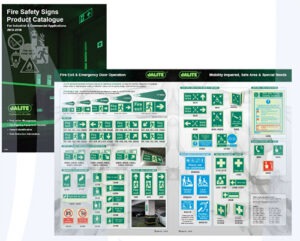
RES are an Authorised Distributor of the JALITE range of photoluminescent safety products which now include fire safety signs, health and safety signs, safety way guidance systems and even photoluminescent paint.

Our Fire Safety Signage Services
■ Fire Safety Signage Sales
■ Fire Safety Signage Installation
■ Fire Safety Signage Guidance, Advice & Training
Our Fire Plan Services
■ Fire Alarm Zone Plans
■ Fire Equipment Plans
■ Fire Escape Plans
■ Fire Evacuation and Procedure Plans
;)
;)