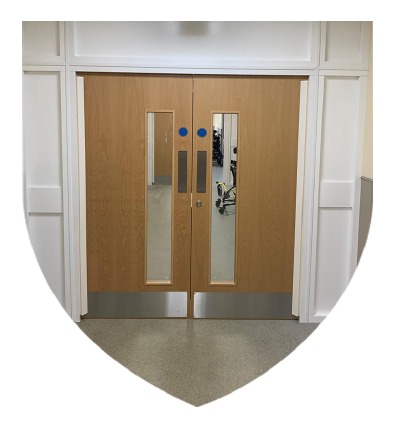
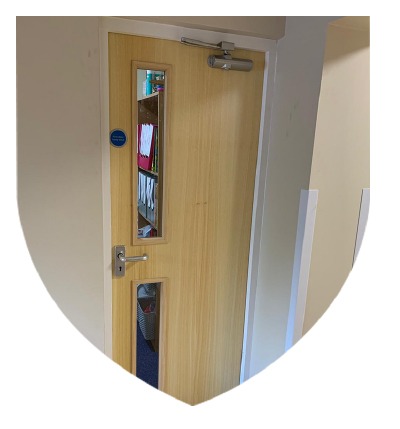
The British Standard for fire doors, BS 8214 has been updated

BS 8214: 2026 – Fire-resisting and smoke control doors – Practical considerations concerning specification, design and performance in use – Code of practice

As of 20th March 2026, the British Standard for fire doors, BS 8214 has been updated.

In summary, BS 8214:2026 supersedes BS 8214:2016 and introduces several important changes:

  • Expands coverage from timber doors to include fire door assemblies of all materials (timber, steel, aluminium, composite), with annexes for material-specific guidance.
    Addresses the lack of a code of practice for metal and composite fire doors, providing new guidance for installation, maintenance and manufacture.
  • Clarifies installation requirements, especially section 9.4, to prevent misinterpretation and non-compliant installations.
  • Updates smoke control guidance to align with revisions in BS 9991, including best practice for sealing under-door gaps.
  • Incorporates changes required by post-Brexit legislation (UKCA and CE marking) and new regulatory requirements from the Building Safety Act, Fire Safety Act and related legislation. Responds to feedback from industry associations, certification bodies and regulatory authorities.
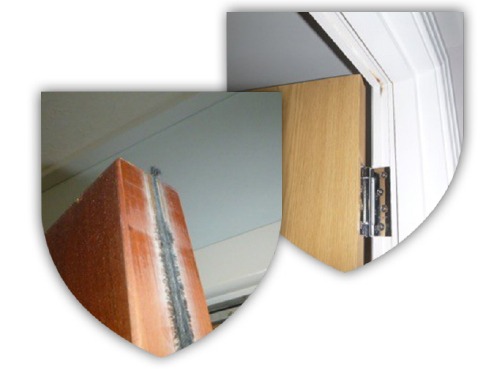
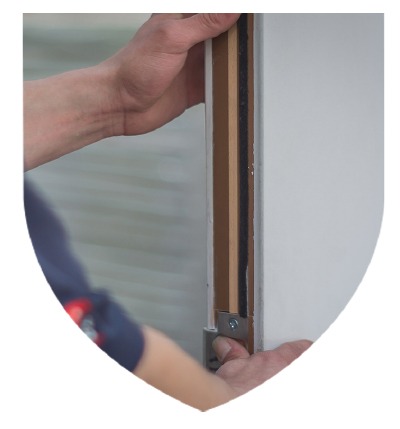
fire door maintenance

BS 8214:2026 in more detail:

What is BS 8214:2026 – Fire-resisting and smoke control doors about?

BS 8214 is the British Standard for fire-resisting and smoke control doors. It provides recommendations and governing principles for the design, specification, installation and maintenance of pedestrian fire-resisting and smoke control doors of all types and materials – including timber, metal, aluminium and composite doors.

The standard aims to ensure that fire doors perform effectively in both new builds and refurbishments, helping to protect escape routes and control the spread of fire and smoke within buildings.

Who is BS 8214:2026 – Fire-resisting and smoke control doors for?

BS 8214 is intended for a wide range of professionals and organizations involved in the provision, specification, installation, inspection and maintenance of fire doors.

This includes:

  • Building designers, specifiers, architects, consultants, engineers, contractors and buyers.
  • Product manufacturers and supply chain providers.
  • Installers, maintenance and repair contractors.
  • Inspectors, fire risk assessors, building control bodies, site managers, supervisors and competent persons.
  • Fire and rescue authorities.
  • Building owners, residents and clients.
  • Insurers and regulators (e.g., Building Control, Building Safety Regulator, Home Office).

What does BS 8214:2026 – Fire-resisting and smoke control doors cover? 

  • Recommendations for the design, specification, installation and maintenance of fire-resisting and smoke control doors.
  • All types and materials of fire doors (timber, metal, aluminium, composite).
  • Performance requirements for fire resistance and smoke control, referencing BS 476-22, BS EN 1634-1, BS 476-31.1 and BS EN 1634-3.
  • Guidance for new builds, refurbishments, replacements, maintenance, improvements and modifications.
  • Step-by-step guidance from industry experts, certification bodies and fire door installation professionals.
  • Important parameters for specification, installation and maintenance to achieve and retain appropriate performance levels.

Why should you use BS 8214:2026 – Fire-resisting and smoke control doors?

  • Fire doors are critical to building fire safety strategies, working in combination with other construction elements to protect escape routes and control fire and smoke spread.
  • The standard is regularly updated to reflect current legislation, including the Fire Safety Act 2021 and 2022, and is referenced in other key standards (BS 9991, BS 9999).
  • It addresses anomalies and misleading information in previous versions, ensuring life safety is prioritised.
  • Using BS 8214 helps ensure fire doors are specified, installed and maintained according to best practice, reducing risk and increasing trust.
  • The revised standard benefits all stakeholders by providing vital guidance, leading to safer buildings and communities.
Upgrading of fire doors

What’s changed?

BS 8214:2026 supersedes BS 8214:2016 and introduces several important changes:

  • Expands coverage from timber doors to include fire door assemblies of all materials (timber, steel, aluminium, composite), with annexes for material-specific guidance.
  • Addresses the lack of a code of practice for metal and composite fire doors, providing new guidance for installation, maintenance and manufacture.
  • Clarifies installation requirements, especially section 9.4, to prevent misinterpretation and non-compliant installations.
  • Updates smoke control guidance to align with revisions in BS 9991, including best practice for sealing under-door gaps.
  • Incorporates changes required by post-Brexit legislation (UKCA and CE marking) and new regulatory requirements from the Building Safety Act, Fire Safety Act and related legislation.
  • Responds to feedback from industry associations, certification bodies and regulatory authorities.
RES Van

Certification Scheme

BM-TRADA Logo

RES are Certified with BM-TRADA.

Scope of certification:

Q-Mark Fire Door Installation
Q-Mark Fire Door Maintenance
Q-Mark Fire Stopping Installation

BM TRADA is a leading provider of third-part certification for fire doors which is why we have invested in becoming a Certificated Company to their Q-Mark schemes.

The BM TRADA Q-Mark Fire Door Installation and Maintenance schemes have been designed to provide reassurance that fire doorsets are being installed and maintained correctly, in accordance with the manufacturer’s instructions or appropriate guidelines.
Fire Door Inspection & Maintenance Guide 2026

Fire Door Inspection & Maintenance Guide 2026

Importance of having compliant fire doors

Compliant and well maintained fire doors will:

■ Hinder the spread of fire throughout a building
■ Hinder the spread of fire, smoke, heat onto escape routes
■ Protect storage areas e.g. Data or combustible materials
■ Provide a minimum of 30 minutes resistance to fire, smoke and heat to compartmentalised safe area

Remember to check for certification

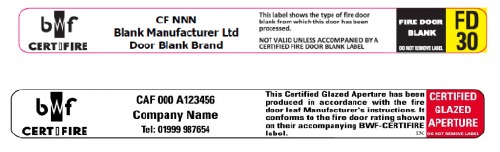
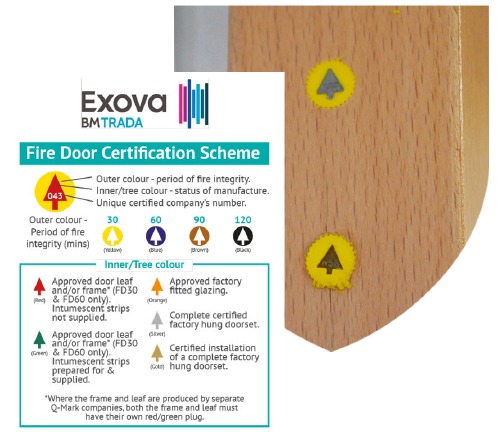
Is there a label or plug on top (or occasionally on the side) of the door to show it is a certificated fire door? You can use the camera your smart phone or a mirror to check. If there is, that’s good news, otherwise report it to whoever is in charge of your building.

* The British Standards Institution has published BS ISO 3941:2026 – Classification of Fires. This introduces Class L for lithium-ion battery fires. However, this class has not yet been incorporated in the BS EN 2 / EN 3 extinguisher fire rating system. (April 2026)

Fire door label
Exova Door Plug

Five Common Door Faults

Missing smoke seals

Over 61% had fire or smoke seals either missing, installed incorrectly or not filling perimeter gaps correctly.

Missing smoke seals
missing signage

Over a third had incorrect or missing mandatory signage.

missing signage
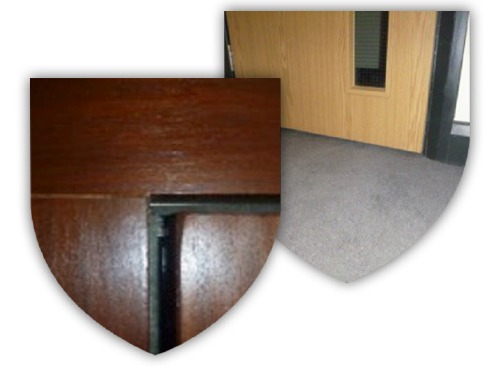
Excessive gaps

More than 230 (34%) fire doors inspected had excessive gaps between the door and its frame (i.e. over 3mm)

Unsuitable hinges
Unsuitable hinges

Almost one in five had unsuitable hinges.

Unsuitable hinges
Leaf damage

Over 15% had damage to the door leaf

Leaf damage

Checking Fire Doors

01

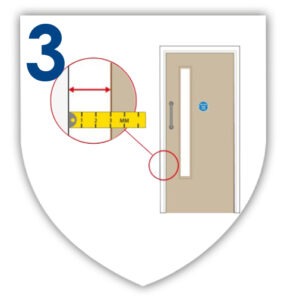
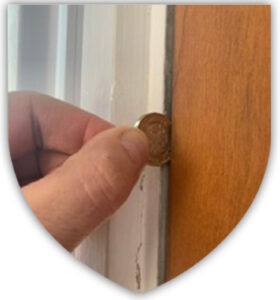
Check the gaps around the top and sides of the door are consistently less than 4mm when closed.

– Use a £1 coin to give a feel for scale, this is about 3mm thick.
– The gap under the door can be slightly larger (up to 8mm is not uncommon), but it does depend on the door – as a rule of thumb, if you can see light under the door, the gap is likely to be too big.
– If the gaps between the door and its frame are too big smoke and fire could travel through the cracks.
– A doors threshold gap should be no more than 10mm, allowing the door to swing unhindered.
– It’s good news if the door fits the frame and both the frame and door are not damaged. While checking for damage and making sure the frame is fitted securely, look out for the doors certification label or plug. This will confirm if the door is fire resistant to 30 or 60 minutes.

Check gaps

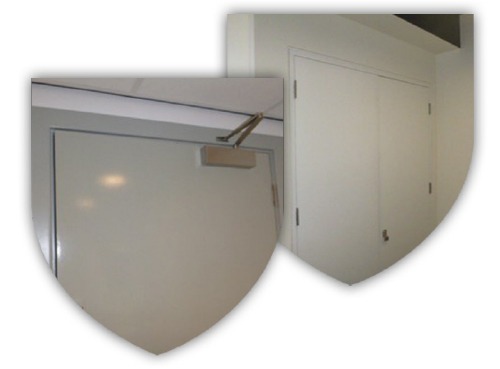
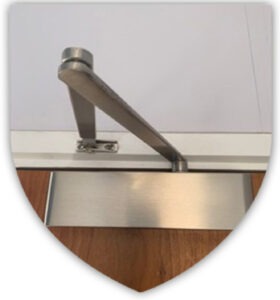
Check that the fire door has a working door closure system and closes correctly as designed.

– Fire doors should be kept closed at all times, or if kept open, should use an automatic release unit when the fire alarm is activated.
– Open the door about halfway, let go and allow it to close by itself.
– Does it close firmly onto the latch without sticking on the floor or the frame?
– A fire door only works when it’s closed. A fire door is completely useless if it’s wedged open or can’t close fully.
– Fire doors that are ‘Kept locked shut’ do not require door closers providing the door is actually kept locked shut!

Door closer

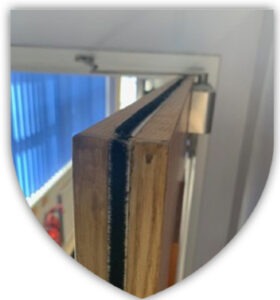
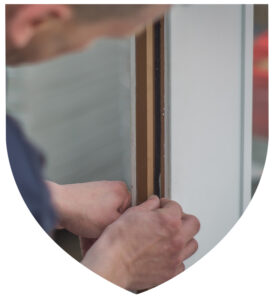
Check that intumescent seals or intumescent cold smoke seals are fitted into a groove in the frame or door.

– Are there intumescent seals or intumescent cold smoke seals around the door or frame?
– If fitted, are they intact with no sign of damage? (Intumescence is a sealing substance that expands in a fire, filling the gap between the door and frame).
– Seals are vital to the fire door’s performance, preventing smoke from passing through the gaps between the door and frame then expanding if in contact with heat, stopping the fire from spreading to other compartments and escape routes.
– Fire doors in older premises may not be fitted with seals but will have one inch door stops.
– See UPGRADING OF FIRE DOORS.

intumescent seals

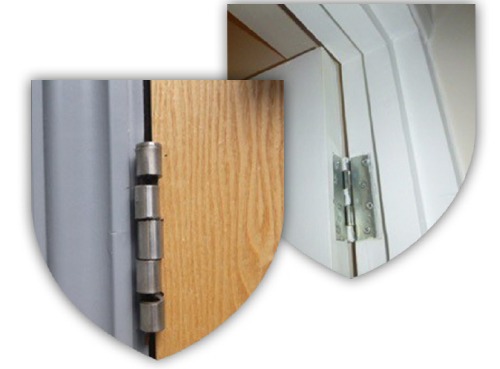
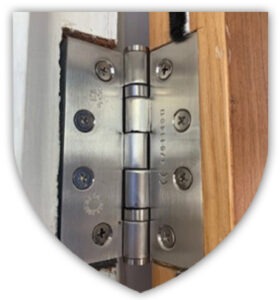
Check that the door has three hinges.

– Hinges must be the correct type, and should have the correct fire rating.
– Three is critical in helping the door stay in position and not break away from the frame in a fire.
– Are the hinges firmly fixed, with no missing or broken screws?
– Are the hinges showing signs of wear?
– Worn hinges will cause the door to drop and gaps between the door and frame to vary eventually causing the door to not close as designed.

Three hinges ?

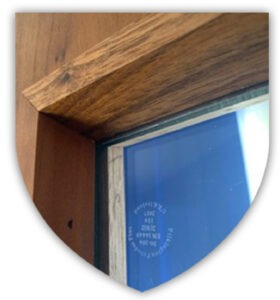
Check vision panels have correctly installed glazing which is appropriately fire rated.

– Fire rated glass vision panels must be installed using intumescent seals. Intumescent helps hold the glass in a fire, maintaining its position under heat.
– Without the use of an intumescent seal the glass will collapse allowing the fire to spread!
– Fire rated glass will have a manufacturers logo complete with product compliance information.
– If in doubt contact the door manufacturer or a third party certified door installer / inspector.

Vision panel glazing

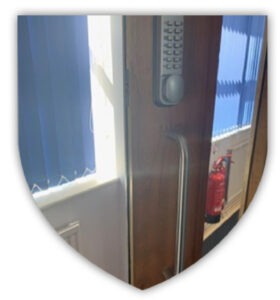
Check that correct door furniture is installed.

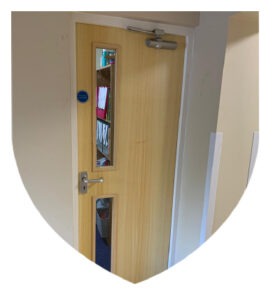
– Ensure that the lock and latch holds the door firmly in place. If it does not this should be resolved – as all fire doors must close firmly into the frame.
– Check manufacturers product information when installing new door furniture, the item may require installing with intumescent material so the doors fire resistance is not compromised.
– Only use approved fire rated products when installing new door furniture. CERTIFIRE is an independent third party certification scheme that assures performance, quality, reliability and traceability of fire protection products.
– If in doubt contact the door manufacturer or a third party certified door installer / inspector

Door furniture

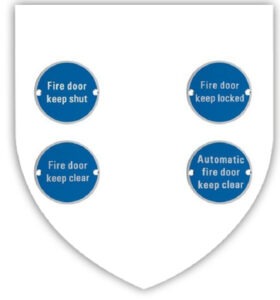
Check that the door has correctly fitted mandatory signage.

– Fire door signage should be positioned at eye level on the door and not on vision panels as this may compromise the fire resistance of the glass.
– Staff, students and visitors can only be expected to use fire doors correctly if instructed.
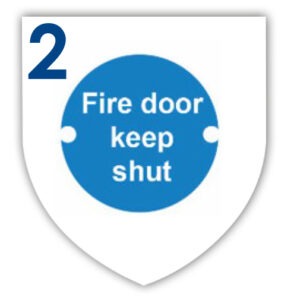
– Cross corridor or room doors opening on to escape routes require ‘Fire door keep shut’ on both faces of each leaf of self closing doors.
– Automatic doors fitted with a device that releases the door in the event of a fire require ‘Automatic fire door keep clear’ placed on the visible side of the door when held open.
– Fire doors without self closing devices i.e. store rooms, risers and services rooms require ‘Fire door keep locked shut’ fixed to the outer door face.

Mandatory door signage

Common Terminology

Description Key
A fire door with 30 minutes integrity and 30 minutes insulation (FD30/30) FD30
A fire door with 60 minutes integrity and 60 minutes insulation (FD60/60) FD60
Smoke Seals (S)
Self Closing-Closed by automatic device MB. See BS 6459 SC
Vision Panel (If in a Fire Door must be FRG) VP
Fire Resistant Glazing (30/60 minutes resistant) FRG
Push Bar PB

Routine fire door inspections and maintenance

BS 9999:2017 Annex I Routine inspection and maintenance of fire safety installations

Daily:
Fire door automatic release mechanisms
All fire doors that are held open by automatic release mechanisms should be released daily.

Monthly:
Automatic opening doors
The operation of fail-safe mechanisms should be tested once a month, either by ”breaking out” the doorset or by simulating failure of the mains power supply, as appropriate. The result of the test should be recorded. Any doors that are found to be faulty should be repaired or replaced.

Doors on hold open devices
The operation of hold open devices should be tested once a month by simulating failure of the mains power supply or operation of the fire detection and alarm system. The result of the test should be recorded. Any doors that are found to be faulty should be repaired or replaced.

Emergency and panic escape doors
The operation of all emergency and panic escape devices, especially on external doors not used for other purposes, should be checked once a month for ease of operation and opening of the door. Weather conditions can effect the door and frame relationship, and therefore the ease of operation of escape devices.

Six-monthly:
All fire doors should be inspected every six month. In particular, it should be ensured that:

a) Heat-activated seals and smoke seals are undamaged;
b) Door leaves are not structurally damaged or excessively bowed or deformed;
c) Gaps between the door leaf and the frame are not so small as to be likely to bind, or so large as to prevent effective fire and smoke-sealing;
d) Hanging devices, securing devices, self closing devices and automatic release mechanisms are operating correctly.

Fire Doors Regulation 10
The Fire Safety (England) Regulations 2022 will make it a legal requirement from 23 January 2023 for
responsible persons for all multi-occupied residential buildings in England with storeys over 11 metres
in height to: undertake quarterly checks of all fire door (including self-closing devices) in the common
partsake – on a best endeavour basis – annual checks of all flat entrance doors (including self-closing
devices) that lead onto a building’s common parts.

For full details, refer to Fact sheet: Fire doors (regulation 10) at the HM Gov Website.

fire door maintenance

Upgrading of fire doors

Upgrading of fire doors

■ Is it worthwhile to upgrade or is a replacement a more effective
alternative?
■ What level of fire resistance is required?
■ Will an upgraded solution satisfy an Enforcement Officer or the
control authority?
■ Has each existing door leaf and frame the potential for being
upgraded?
■ Has the method of improving the burn-through resistance of the
door leaf been proven or does it need assessment by a specialist?
■ Has the door to frame gap been upgraded in terms of fit,
intumescent protection and smoke sealing?
■ Is the frame adequate and sufficiently well sealed into the wall?
■ Is the ironmongery appropriate for use on a fire resisting doorset?

If in doubt about any of the above, contact a competent fire door installer / inspector.

RES Van

Certification Scheme

BM-TRADA Logo

RES are Certified with BM-TRADA.

Scope of certification:

Q-Mark Fire Door Installation
Q-Mark Fire Door Maintenance
Q-Mark Fire Stopping Installation

BM TRADA is a leading provider of third-part certification for fire doors which is why we have invested in becoming a Certificated Company to their Q-Mark schemes.

The BM TRADA Q-Mark Fire Door Installation and Maintenance schemes have been designed to provide reassurance that fire doorsets are being installed and maintained correctly, in accordance with the manufacturer’s instructions or appropriate guidelines.
Download Fire Door Inspection & Maintenance Guide 2026

65% of social housing fire doors “failing safety standards”

65% of social housing fire doors “failing safety standards”

SENTRY FIRE Safety Group has published the findings from its comprehensive nine-month investigation into the safety of social housing fire doors across England.

The report, entitled ‘A Burning Issue: The Reality of Fire Door Safety in Social Housing’, reveals “systemic shortcomings” in fulfilling the requirements of the Fire Safety (England) Regulations 2022, highlighting “a clear gap” between the intent of post-Grenfell fire safety legislation and reality: a gap that leaves residents “exposed to avoidable risk”.

Fire door inspection from RES Fire & Security

Based on Freedom of Information (FoI) data emanating from 88% of England’s local authorities, the research provides the first national ‘snapshot’ of fire door compliance since mandated annual inspections were introduced back in January 2023.

Three-pillar failure: inspection, performance and remediation

The findings identify a critical gap between legislative intent and ‘on the ground’ delivery across three key areas: inspection, performance and remediation.

Despite a legal requirement for annual checks, the majority of social housing fire doors remain uninspected. Only 46% of flat entrance doors and 89% of communal doors have been inspected even once since January 2023.

Two-thirds of fire doors (63% of entrance doors and 67% of communal doors) failed to meet the FD30 legal minimum (a 30-minute fire-resistance standard that has been a Building Regulations requirement for over 30 years).

Accountability is stalling. 63% of non-compliant doors are still awaiting repair or replacement, while 51% of local authorities currently have no formal plan in place for remediation work.

Regionally, the underlying data shows even greater variation, both in terms of  performance standards and levels of inspection activity. Further, the research presents only a partial picture. Housing associations manage similar numbers of properties, but are exempt from FoI requests so there’s limited transparency on their inspection and compliance rates. Sentry Fire Safety Group estimates similar levels of underperformance and non-compliance.

Systemic constraints

There are well-recognised and systemic constraints behind these outcomes, which are identified in the report. Although Sentry Fire Safety Group initiated this research, the organisation believes that a cross-industry and multi-agency approach is essential to counter these constraints and ensure meaningful change.

Sentry Fire Safety Group engaged with policymakers, regulators and industry leaders ahead of the report’s publication and the findings were peer reviewed and validated at an industry and policy meeting, at which point recommendations for structural solutions were gathered.

Jon Gatfield, executive chair at the Sentry Fire Safety Group, explained: “It has been three years since the Fire Safety (England) Regulations came into force and our research shows that implementation has not progressed at the pace required to protect residents. Without intervention, non-compliance will persist.”

Gatfield added: “We are not here to apportion blame. Our goal in publishing this research is simple: to support measurable risk reduction, drive stronger accountability and strengthen protection for residents. We believe there’s a need for a co-ordinated and cross-sector response to ensure safety obligations are delivered in practice, not just in principle.”

Bob Blackman MP, chair of the All-Party Parliamentary Group on Fire Safety and Rescue, observed: “Fire safety failures are preventable. We must address the structural weaknesses, from funding to greater transparency, before further risk accumulates so that we can ensure every resident is protected by standards that are actually enforced. Addressing these issues is critical to safeguarding vulnerable tenants and ensuring that homes are genuinely safe from fire. With collective action, we have a chance to turn regulation into reality.”

*Access copies of the White Paper online at https://sentrydoors.co.uk/wp-content/uploads/2026/03/Fire-Safety-In-Social-Housing.pdf

Research impetus and methodology

As a supplier to the sector, Sentry Fire Safety Group had long suspected that the mandated inspection and remediation programme for fire doors wasn’t progressing at the rate required. In the absence of any data, the national evidence-based research project was initiated to quantify the extent of the issue.

FoI requests were submitted to 296 local authorities across England to obtain direct and verifiable data. As stated, 88% of local authorities (ie 261) responded to the request, with 176 (67%) authorities providing usable data. 75 local authorities (ie 29%) reported that their social housing is managed by housing associations and therefore resides outside the scope of FoI requests. Only ten (ie 3%) formally declined to provide data.

Headline data for each region can be found in the report and underscores the “uneven progress” in fire door compliance across England. Reflecting its concentration of high-rise housing stock, London presents the highest risk concentration with the lowest front door inspection rate (33%) and FD30 certification (19%) and the highest number of non-compliant doors (44,129), representing 66% of all non-compliant doors in England.

The North East shows particularly low certification levels (20% front doors, 10% communal) despite strong communal inspection coverage (99%). The South West demonstrates the strongest communal inspection performance (98%) and high communal FD30 compliance (97%).

Fire Door Safety in Social Housing Industry Round Table

The Fire Door Safety in Social Housing Industry Round Table took place on 26 February and included representatives from Fire Door Maintenance, UAP, STARK UK, George Boyd, CLC, the Fire Door Association and the Fire Safety Unit at the Ministry of Housing, Communities and Local Government.

The Fire Door Safety in Social Housing Policymakers’ Round Table took place on 2 March and included representatives from the All-Party Parliamentary Group on Fire Safety and Rescue, the Building Safety Regulator, the Fire Safety Unit at the Ministry of Housing, Communities and Local Government, the Association of British Insurers and the London Fire Brigade.

The Sentry Fire Safety Group is a specialist manufacturer of timber fire and security door sets for the social housing, public sector, commercial and residential markets. Operating nationally from two manufacturing facilities in Doncaster and Birmingham, Sentry Fire Safety Group has established a strong reputation for manufacturing products that meet the most rigorous quality and fire certification standards. Its commitment to regulatory compliance and high manufacturing standards has resulted in independent third party accreditations from Certifire and BM Trada Q-Mark.

*Further information is available online at www.sentryfiresafetygroup.co.uk and www.sentrydoors.co.uk


Article originally published on Fire Safety Matters

Fire Door Safety Week 2025

Fire Door Safety Week 2025

FREE WEBINARS - REGISTER NOW

The British Woodworking Federation’s Fire Door Safety Week aims to raise the awareness of the critical role that fire doors play in saving lives and protecting property in the unfortunate event of a fire.

The Fire Door Safety Week campaign will be taking place between the 22nd and 26th September 2025.

Everyone plays their part in ensuring a fire door performs as it should in the tragic event of a fire, from the manufacturer through to the building users, and knowing what to look out for and what to do if you spot a problem might just save a life.

The British Woodworking Federation have released the webinar programme for this year’s Fire Door Safety Week campaign.

“To support this important initiative, we’ve organised a series of free webinars featuring industry experts from National Fire Chiefs Council (NFCC), Fire Door Inspection Scheme FDIS®️, Historic England , BSI and our own Technical Director Kevin Underwood. These sessions will cover recent legislative developments and highlight key messages around fire door safety.”

“FDSW aims to raise awareness of fire safety, underline the critical role of fire doors, and encourage people to report concerns about poor installation, maintenance, or misuse.”

The webinars are designed to provide clear, practical insights to help you stay informed and support safer buildings for everyone.

Fire Safety for Property Managers and Facilities Management

Fire Safety for Property Managers and Facilities Management

Ensuring that compliant fire safety procedures and services are in place is an essential part of property management. Your legal responsibilities as a property manager will require you to cover various aspects of compliance such as the service and maintenance of all the fire protection measures in a premises.

As a property manager or facilities manager you should be aware of the requirements necessary to ensure fire safety compliance is achieved across your properties.

We recommend fire risk assessments are carried out by an independent and suitably qualified assessor / company that is not associated to the company responsible for providing the premises fire safety service and maintenance services to avoid any potential conflict of interests. RES do not undertake fire risk assessments for this reason.

The premises fire risk assessment should be kept up to date, detailing the fire safety measures in place with the assessor making recommendations to ensure they are compliant.

Residential properties may have, for example, fire detection and alarm system, emergency lighting, fire doors, dry risers, smoke control systems and portable fire equipment

Fire Detection and Alarm Systems

Fire alarm systems must be serviced every six months as required by British Standard 5839

Various grades of system are appropriate for residential properties, from Grade A, providing the highest level of fire detection and alarm system, to a Grade D1 system.

Various fire alarm equipment is available and more information on these can be found on our fire alarm service page

RES are BAFE SP203-1 certificated for Fire Detection and Alarm Systems: Third-party certificated by BSI, giving you assurance and peace of mind.

Emergency Lighting

Emergency lighting is a requirement in HMOs under British Standard 5266-1 and an engineer should attend site twice a year to complete a full service across all devices.

There are various types of emergency lights which are outlined in our emergency light service page

RES have BAFE SP203-4 Emergency Lighting: Third-party certificated by BSI, giving you assurance and peace of mind.

Fire Doors

Effective fire-resisting doors are vital to ensure occupants are able to evacuate to a safe place.

As per the “Fire Safety (England) Regulations 2022”, routine fire door checks should be undertaken by the responsible person.

Any damage or defects are reported and remedied in a timely manner by the responsible person.

RES are BM-Trada Q Mark registered for fire door maintenance and installation.

Dry Risers

A Dry Riser is a system of pipes and valves installed in tall buildings or building with restricted access that enables the fire brigade to pump water to specific predetermined points within the building.

The buildings “Responsible Person” (RP) is required to maintain the system to BS 9990 – Code of practice for non-automatic fire fighting systems in buildings, and ensure maintenance frequency and procedures are in accordance with BS 9999 – Code of practice for fire safety in the design, management and use of buildings, or as specified  by the buildings Fire Risk Assessment (FRA).

BS 9990 requires the system to undergo an annual static pressure test and inspection and a six monthly visual inspection, by a competent person. Thus ensuring the Dry riser system is maintained and functioning correctly for the fire brigade at all times.

Smoke Control an Ventilation Systems

Smoke control and ventilation systems vent smoke out of a building in the event of a fire and are used in residential, commercial, healthcare or educational premises.

Smoke Vent Systems should be serviced a minimum of once a year as per the RRO (The Regulatory Reform (Fire Safety) Order 2005, article 17) and  BS 7346-8:2013 and relevant parts of BS EN 12101 for Smoke and heat control systems.

RES can provide a comprehensive Smoke Control and Ventilation service.

Fire Extinguishers

The annual servicing of fire extinguishers is a requirement of British Standard 5306

The Regulatory Reform (Fire Safety) Order 2005 states that houses of multiple occupancy (HMOs) should have fire extinguishers installed. The quantity and placement of these would be outlined in the fire risk assessment.

There are various types of fire extinguisher as outlined on our fire extinguishers service page

RES provide a comprehensive fire extinguisher service and are BAFE (SP101) registered, giving you assurance and peace of mind.

Uptick Maintenance Platform

RES use the leading fire and security maintenance platform Uptick, which provides us and our customers with a clear picture of the service schedules, any defects and invoices. Each customer can be provided client portal access which gives accurate and up-to-date information on all their managed properties in once place.

Whether you are managing one, or a portfolio of properties, our service and maintenance services will help to ensure your premises are fire safety compliant.

Contact Us

Call 0800 731 0727

Email: sales@resfire.co.uk

Contact Us

Areas we cover

RES cover the South of England including the counties of Middlesex, Essex, Kent, East Sussex, West Sussex, Surrey, Hampshire, Dorset, Wiltshire, Gloucestershire, Berkshire, Oxfordshire, Buckinghamshire, Hertfordshire including London, Brighton, Portsmouth, Southampton, Winchester, Bristol, and the surrounding towns of Alton, Aldershot, Andover, Basingstoke, Beaconsfield, Bracknell, Cirencester, Egham, Farnham, Guildford, Henley on Thames, High Wycombe, Maidenhead, Marlow, Newbury, Oxford, Poole, Reading, Slough, St Albans, Staines, Swindon, Watford, Windsor, Woking, Wokingham and Worthing.

Fire Door Safety Week 2024

Fire Door Safety Week

23-27 September 2024

RES Fire Supports:

Fire Door Safety Week 2024.

23-27 SEPTEMBER 2024

Organised by The British Woodworking Federation, Fire Door Safety Week informs and educates on the importance of ensuring Fire Doors are properly installed and maintained.

A series of free webinars are available via

https://www.firedoorsafetyweek.co.uk/events/

hashtagfiredoors hashtagfiredoorsafety hashtagpassivefire

Fire Door Safety Week 2024 Events

Register for one, or all of our informative webinars taking place during British Woodworking Federation’s Fire Door Safety Week 2024. The webinars are free to attend, and open to everybody.

Monday 23rd September 2pm. Andrew Sayer, Lead Assessor FDIS

Title: Common Issues Surrounding Fire Doors

REGISTER HERE

***

Tuesday 24th September 11am. Kevin Underwood, Technical Director- BWF

Title: Fire doors in the Grenfell Tower Inquiry *Phase 2 report

*due to be published on 4 September

REGISTER HERE

***

Thursday 26th September 11am. Kevin Underwood, Technical Director- BWF

Title: The draft for public comment of the revised *BS 8214 the code of practice for fire doors

*due to be released by BSI next month and FDSW sits within the commenting period

REGISTER HERE

***

Friday 27th September 11am. Ashley Mather, Senior Fire Engineer- NFCC

Title: Fire doors – a fire service perspective

REGISTER HERE

Fire Door Safety Advice

Every year, Fire Door Safety Week raises awareness and helps save lives. We need to root out fire doors that are ill-fitted, damaged or poorly maintained and ensure that all buildings are equipped with fire doors that are fit for purpose.

Tenants and residents need to have confidence in them and have clear guidance about fire safety plans and measures, and be able to report concerns that are then actioned. The time has come for all parties to fully play their role in the critical matter of fire safety and this is why we have created this dedicated advice page.

Fire Door Safety Week Advice Page


It’s Fire Door Safety Week 2023

DON'T TURN A BLIND EYE TO FIREDOOR REGULATIONS.

25-29 September 2023

This week sees the 10th Annual Fire Door Safety Week, run by the British Woodworking Federation

“The British Woodworking Federation’s Fire Door Safety Week aims to raise the awareness of the critical role that fire doors play in saving lives and protecting property in the unfortunate event of a fire.”

“Everyone plays their part in ensuring a fire door performs as it should in the tragic event of a fire, from the manufacturer through to the building users, and knowing what to look out for and what to do if you spot a problem might just save a life.

FREE EVENTS AND TOOLKITS

Fire Door Safety Week 2023 Events

Monday 25th September 2023

10.00am – 11.00am

Kevin Underwood – BWF Technical Director

Title:  The review of BS 8214: 2016, Timber Based Fire Door Assemblies – Code of Practice


Tuesday 26th September 2023

10.30am – 11.30am

Ashley Mather – Senior Fire Engineer, National Fire Chiefs Council (NFCC)

Title: Fire doors in Residential Buildings: regulation and compliance


Wednesday 27th September 2023

10.30am – 11.30am

Andrew Sayer – Lead Assessor Fire Door Inspection Service (FDIS)

Title: The top 5 things you need to know about fire door inspections.

Register Here 


Campaign Info Pages

FDSW23 Recognise it, Report it

The theme for this year’s campaign, which runs from 25 – 29 September, is ‘Recognise it, Report it’ and aims to help people spot problems with faulty doors so they can be reported, then repaired or replaced.

https://www.firedoorsafetyweek.co.uk/fdsw23-recognise-it-report-it/

Our Fire Door Services

Effective fire-resisting doors are vital to ensure occupants are able to evacuate to a safe place. Correctly specified and installed doors will hold back fire and smoke, preventing escape routes becoming unusable as well as preventing the spread of fire.

  • – Fire Door Installation
  • – Fire Door Inspections and Maintenance
  • – Fire Door Repairs

British Woodworking Federation Campaign Video

Fire-Rated Doors

Fire-Rated Doors

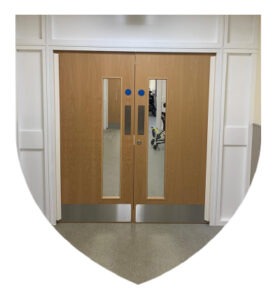
The law states that buildings and premises must be compartmentalised to prevent the spread of fire from one area to another. Such compartmentalisation is achieved through the use of fire-rated doors, which help to contain a fire while enabling occupants to safely evacuate a building. Effective fire-rated doors are essential to keep the occupants of a building safe. Correctly made and installed doors will hold back fire and smoke, preventing the spread of fire while helping escape routes to remain accessible. Fire-rated doors have two important functions in the case of a fire emergency – they hold back smoke and flames to stop them from spreading (when closed), and provide an effective means of escape (when opened). Every fire-rated door acts as a barrier to the passage of fire and smoke. There are two main categories of fire-rated doors – FD30 and FD60, offering 30 and 60 minutes of protection against fire. Fire doors must always be kept shut and not left open. If you leave a fire door open, you are breaking UK fire safety regulations.

At RES Fire Protection Engineers, we have everything you need to carry out timber fire-rated door inspections, maintenance, repairs, and we can also offer guidance and advice on the types of fire-rated doors you require for your premises.

What is a fire-rated door made of?

Most fire-rated doors are made from timber and are tested to see if they meet current legislation requirements and to ensure that they resist a fire for a specified period of time. Only a fire-rated door that has been properly constructed, certified and correctly installed will be able to contain the spread of smoke and eventually a fire. Metal fire-rated doors are also available in the UK. The level of protection provided by a fire-rated door is determined by the length of time that a door can hold back flames. Once a door’s integrity has been breached, it is no longer effective. Some doors hold back flames for 30 minutes, while others can hold flames back for one or two hours. It is possible to upgrade the fire resistance of the current timber fire-rated doors in your premises. Speak to our team to see how we can help you achieve this.

Fire-rated door inspections

Fire-rated doors should be inspected on a six-month basis to ensure that their integrity is intact. Our fire-rated door inspections at RES Fire Protection Engineers are designed to identify issues or problems with fire-rated doors such as:

  • Self-closing devices that are not working correctly, or are missing
  • Damage to fire-rated doors
  • Removal of locks without suitable repairs
  • Poorly fitting doors that have been caused by shrinkage or distortion
  • Damage to doors from wear and tear
  • Inappropriate door furniture
  • Missing or incorrect mandatory door signage


We can also install timber fire-rated door sets in places where they should be positioned in a building. Speak to us today about the requirements of your premises, or we can carry out an inspection for you and advise on where you should position fire-rated doors. We also provide fire door reports and surveys, which are usually costed per door. You will receive a report with photos, containing advice and details relating to your premises.

Fire-rated doors can save lives if implemented correctly. Every building layout is different, therefore different premises will require different fire-rated door plans. We can advise on the correct fire-rated door solutions for your premises. We cover the South of England including London, Berkshire, Bracknell, Windsor, Middlesex & Surrey, Oxfordshire, Hampshire, Buckinghamshire, Hertfordshire, Essex & Kent, West & East Sussex, Reading, Maidenhead, Slough, Newbury and the surrounding areas.