Emergency Lighting Guide

EMERGENCY LIGHTING GUIDE

Emergency lighting and guidance lighting is essential for the safety of occupants within a building where a sudden loss of light would prevent safe passage from the premises.

The Regulatory Reform (Fire Safety) Order 2005 and British Standard 5266 Part 1:2025 – Emergency lighting of premises. Code of practice, provides general guidance on the provision and operation of emergency lighting.

The Responsible Person

Current legislation requires the premises “Responsible Person”, to consider all aspects of fire safety within their premises and included in this requirement is the provision of emergency lighting systems.

The “Responsible Person” has a legal duty to have a premises fire risk assessment (FRA) which identifies hazards and risks.

FRA guidance for all types of premises except individual dwelling houses state that emergency lighting is needed in the following circumstances:

■ To adequately illuminate designated escape routes
■ To provide sufficient illumination in other areas to allow safe movement towards and through escape routes
■ To ensure that all fire alarm call points, fire fighting equipment and other safety equipment can be readily located and used
■ To provide sufficient light to enable proper shut down procedures to be carried out in dangerous or high risk areas etc.

Does my premises need Emergency Lighting ?

The legal requirement is that most non-domestic and commercial premises must be safe at all times, even if mains power failure occurs. Therefore, most buildings must have emergency lighting fitted such as shops, factories, warehouses, schools, colleges, universities, hospitals, care homes, offices, public areas of residential blocks, common areas in flats, HMOs, rail stations, airport terminals, car parks, leisure centres, gyms, theatres, pubs, clubs, places of worship, community halls, tents and marquees.

Emergency lighting is generally not required in private, single-occupancy houses.

How is Emergency Lighting used ?

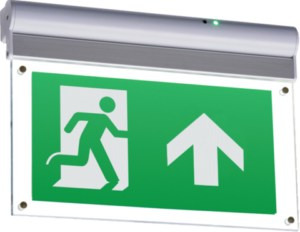
Illuminated Escape / Exit Signs

Defined Escape Routes – Corridors, stairways, and final exits must be illuminated

Emergency Light Large Open Areas

Large Open Areas – Areas accessible by the public that are larger than 60m2 and open areas with an escape route running through them must have emergency lighting installed to ensure users safety, guiding them to the nearest exit.

Emergency Light - Large Open Area

High Risk Task Areas – High-risk task area lighting needs to operate in the event of an emergency to keep them illuminated

Standby Lighting

Standby lighting – Maintains business continuity (e.g., finishing a critical, dangerous, or high-value task). Standby lighting is not a legal requirement.

How long should emergency lighting last ?

1 hour minimum duration (autonomy) for emergency lighting:

Must fully recharge within 24 hours before reoccupation
Premises must be evacuated immediately

one hour

3 hour duration of emergency lighting for:

Sleeping risk (hotels)
Licenced premises and places of entertainment
Premises requiring early reoccupation (schools, hospitals)

Threehours

Types of Emergency Lighting

Maintained: The emergency light operates as a normal light, but switches to a battery backup during a power failure.

Non-Maintained: The light is usually not illuminated and only turns on when the mains power fails.

Combined: multi-lamp luminaires where the emergency lamp can be operated in a non maintained or a maintained mode.

Emergency Light Examples

Illuminated Escape / Exit Signs

Illuminated Escape / Exit Signs

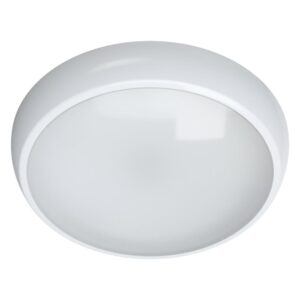
Emergency Light - Bulkhead Lights

Bulkhead Lights

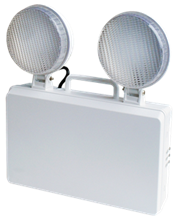
Twin Spot Emergency Light

High output twin spotlights

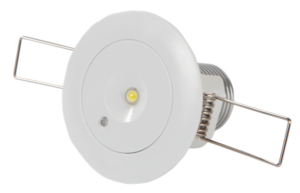
Emergency lighting Recessed Downlight

Recessed Downlights

Emergency Light Levels

Escape sign illumination
Escape signs may be either externally or internally illuminated to ensure they are conspicuous and legible. Externally illuminated signs should be illuminated to no less than 5 lux

Defined Escape Routes
Routes occupants must follow to evacuate  the premises
1 lux minimum
At least 2 luminaires per compartment

Open Areas
Areas >60m2
0.5 lux minimum (excluding 0.5m border  at edge of area)
If the escape route runs through open area, escape route still 1 lux

High-risk Task Areas
Done on case-by-case basis as part of the site risk assessment
10% of light required for the task
Never less than 15 lux

1 lux = one lumen per square metre.

British Standard BS 5266-1:2025 Emergency lighting of premises. Code of practice

BS 5266-1 is a British Standard that provides detailed guidance on the design, installation, and maintenance of emergency lighting systems. Adhering to this standard ensures that systems are not only compliant with legal regulations but also perform effectively during emergencies.

Key recommendations outlined in BS 5266-1 include:

Emergency lighting must be installed to illuminate escape routes, open areas, fire signage, fire alarms, and equipment storage points.
Systems should activate automatically within one second of mains power failure.
Emergency lighting should provide sufficient illumination for a minimum of one hour, with three hours recommended in many cases.
Regular testing and maintenance are required to ensure the system remains in proper working order.

Adherence to BS 5266-1 is essential for ensuring that emergency lighting is suitable for its intended purpose and contributes to overall fire safety compliance.

Emergency Lighting Testing

BS EN 50172:2004 / BS 5266-8:2004 requires that installed emergency lighting systems shall have continued maintenance and periodic testing carried out, as defined in the dual numbered standard. In practice, the emergency luminaires require a daily visual inspection (subject to the premises FRA requirements) and must be functionally tested every month and for their full rated duration annually.

The purpose of this periodic testing is to ensure the satisfactory operation of each emergency luminaire, to establish that the light output from each luminaire is sufficient, and ultimately that the system is still fit for purpose and that it corresponds with the requirements of the standards.

For safety reasons, the standards advise that the emergency lighting testing should be carried out at times of least risk to the building’s occupants or if possible, when the premises are unoccupied or in unoccupied portions of those premises

Common premises emergency lighting issues

Batteries not replaced, leading to reduced duration
Faulty LED charging indicators not spotted due to lack of regular inspection and testing
Escape routes changed without updating the lighting layout
Little or no lighting on external escape routes to assembly points
Cheap units installed that do not meet the required standards
Decorative refurbishments covering or obstructing emergency lights

These are all fixable quickly once identified by a competent engineer.

How we can help
tiny-bafe-id-logo-small

RES can advise on all aspects of Emergency Lighting.

Our accreditation to the Third- Party Certificated BAFE SP203-4 Emergency Lighting Systems Scheme ensures that we are a trusted provider of:

■ Emergency Lighting Maintenance
■ Emergency Lighting Monthly inspections
■ Emergency Lighting Annual discharge testing
■ Emergency Lighting Fault Finding and repairs
■ Emergency Lighting Design and installation

Call us on 0800 731 0727 or use the Contact Form

Download the Emergency Lighting Guide

References

The Regulatory Reform (Fire Safety) Order 2005

https://www.legislation.gov.uk/uksi/2005/1541/contents/made


Hochiki BS5266 Part 1:2025 Guide

A handy pocket-sized guide to the design, installation and wiring of emergency lighting systems based on key aspects of BS5266 Part 1:2025, please use the button below to download.

https://assets.hochikiglobal.com/assetbank-hochikieurope/assetfile/15881.pdf

Premises FRA Information

The responsible person must carry out and regularly review a fire risk assessment of the premises. This will identify what you need to do to prevent fire and keep people safe.

https://www.gov.uk/workplace-fire-safety-your-responsibilities/fire-risk-assessments
Fire Safety for Property Managers and Facilities Management

Fire Safety for Property Managers and Facilities Management

Ensuring that compliant fire safety procedures and services are in place is an essential part of property management. Your legal responsibilities as a property manager will require you to cover various aspects of compliance such as the service and maintenance of all the fire protection measures in a premises.

As a property manager or facilities manager you should be aware of the requirements necessary to ensure fire safety compliance is achieved across your properties.

We recommend fire risk assessments are carried out by an independent and suitably qualified assessor / company that is not associated to the company responsible for providing the premises fire safety service and maintenance services to avoid any potential conflict of interests. RES do not undertake fire risk assessments for this reason.

The premises fire risk assessment should be kept up to date, detailing the fire safety measures in place with the assessor making recommendations to ensure they are compliant.

Residential properties may have, for example, fire detection and alarm system, emergency lighting, fire doors, dry risers, smoke control systems and portable fire equipment

Fire Detection and Alarm Systems

Fire alarm systems must be serviced every six months as required by British Standard 5839

Various grades of system are appropriate for residential properties, from Grade A, providing the highest level of fire detection and alarm system, to a Grade D1 system.

Various fire alarm equipment is available and more information on these can be found on our fire alarm service page

RES are BAFE SP203-1 certificated for Fire Detection and Alarm Systems: Third-party certificated by BSI, giving you assurance and peace of mind.

Emergency Lighting

Emergency lighting is a requirement in HMOs under British Standard 5266-1 and an engineer should attend site twice a year to complete a full service across all devices.

There are various types of emergency lights which are outlined in our emergency light service page

RES have BAFE SP203-4 Emergency Lighting: Third-party certificated by BSI, giving you assurance and peace of mind.

Fire Doors

Effective fire-resisting doors are vital to ensure occupants are able to evacuate to a safe place.

As per the “Fire Safety (England) Regulations 2022”, routine fire door checks should be undertaken by the responsible person.

Any damage or defects are reported and remedied in a timely manner by the responsible person.

RES are BM-Trada Q Mark registered for fire door maintenance and installation.

Dry Risers

A Dry Riser is a system of pipes and valves installed in tall buildings or building with restricted access that enables the fire brigade to pump water to specific predetermined points within the building.

The buildings “Responsible Person” (RP) is required to maintain the system to BS 9990 – Code of practice for non-automatic fire fighting systems in buildings, and ensure maintenance frequency and procedures are in accordance with BS 9999 – Code of practice for fire safety in the design, management and use of buildings, or as specified  by the buildings Fire Risk Assessment (FRA).

BS 9990 requires the system to undergo an annual static pressure test and inspection and a six monthly visual inspection, by a competent person. Thus ensuring the Dry riser system is maintained and functioning correctly for the fire brigade at all times.

Smoke Control an Ventilation Systems

Smoke control and ventilation systems vent smoke out of a building in the event of a fire and are used in residential, commercial, healthcare or educational premises.

Smoke Vent Systems should be serviced a minimum of once a year as per the RRO (The Regulatory Reform (Fire Safety) Order 2005, article 17) and  BS 7346-8:2013 and relevant parts of BS EN 12101 for Smoke and heat control systems.

RES can provide a comprehensive Smoke Control and Ventilation service.

Fire Extinguishers

The annual servicing of fire extinguishers is a requirement of British Standard 5306

The Regulatory Reform (Fire Safety) Order 2005 states that houses of multiple occupancy (HMOs) should have fire extinguishers installed. The quantity and placement of these would be outlined in the fire risk assessment.

There are various types of fire extinguisher as outlined on our fire extinguishers service page

RES provide a comprehensive fire extinguisher service and are BAFE (SP101) registered, giving you assurance and peace of mind.

Uptick Maintenance Platform

RES use the leading fire and security maintenance platform Uptick, which provides us and our customers with a clear picture of the service schedules, any defects and invoices. Each customer can be provided client portal access which gives accurate and up-to-date information on all their managed properties in once place.

Whether you are managing one, or a portfolio of properties, our service and maintenance services will help to ensure your premises are fire safety compliant.

Contact Us

Call 0800 731 0727

Email: sales@resfire.co.uk

Contact Us

Areas we cover

RES cover the South of England including the counties of Middlesex, Essex, Kent, East Sussex, West Sussex, Surrey, Hampshire, Dorset, Wiltshire, Gloucestershire, Berkshire, Oxfordshire, Buckinghamshire, Hertfordshire including London, Brighton, Portsmouth, Southampton, Winchester, Bristol, and the surrounding towns of Alton, Aldershot, Andover, Basingstoke, Beaconsfield, Bracknell, Cirencester, Egham, Farnham, Guildford, Henley on Thames, High Wycombe, Maidenhead, Marlow, Newbury, Oxford, Poole, Reading, Slough, St Albans, Staines, Swindon, Watford, Windsor, Woking, Wokingham and Worthing.

Types of Emergency Lighting

Types of Emergency Lighting

RES can provide a wide range of Emergency Lights for your business premises. Emergency escape lighting is defined as “that part of emergency lighting that is provided to enable safe exit in the event of failure of the normal supply”.

As well as highlighting fire exits, emergency lighting provides essential illumination throughout escape routes including steps, stairways, changes in direction and fire and first aid points.

The design and placement of Emergency Lighting is subject to BS EN 1838:2013 which specifies escape and standby lighting requirements for businesses in the event of a power failure.

What is maintained and non-maintained emergency lighting?

A maintained emergency light is always on and will stay illuminated in the event of a power failure. These lights are usually installed in communal areas such as corridors and stair wells.

A non-maintained emergency light only comes on in the event of a power failure. These lights will usually be installed in areas that don’t need a permanent light source.

Typical Products Used

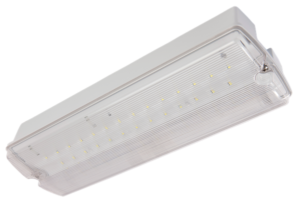
LED Bulkhead Emergency Light

Designed to provide emergency lighting and illuminate escape routes during a power cut

  • – LED Light Source
  • – 3 Hour Emergency Duration
  • – Suitable for ceiling and wall mounting
  • – Maintained or Non-Maintained

Wall/Ceiling Mounted LED Emergency Exit Sign

Designed for ceiling/wall mounting along corridors that form part of the escape route

  • – LED Light Source or 8-Watt Fluorescent Tube
  • – 3 Hour Emergency Duration
  • – Suitable for ceiling and wall mounting
  • – Maintained or Non-Maintained

Round Bulkhead Light

Designed to provide emergency lighting and illuminate escape routes during a power cut

  • – LED Light Source
  • – 3 Hour Emergency Duration
  • – Suitable for ceiling and wall mounting
  • – Maintained or Non-Maintained

LED Twin Spot Emergency Light

Designed for large or high areas such as escape routes, sports stadiums, high bay warehouse, car workshops, racked areas and railway stations

  • – LED Light Source
  • – 3 Hour Emergency Duration
  • – Suitable for wall mounting
  • – Non-Maintained

Emergency Downlights

Emergency downlights are designed to be small and unobtrusive yet highly effective in the event of a loss of mains power.

  • – LED Light Source
  • – 3 Hour Emergency Duration
  • – Discreet ceiling mounting
  • – Maintained or non-maintained

Emergency lighting testing

British Standard 5266: Part 8 requires that installed emergency lighting systems shall have continued maintenance and periodic testing carried out, as defined in the standard. In practice, the emergency luminaires must be functionally tested every month and for their full rated duration annually.

The purpose of this periodic testing is to ensure the satisfactory operation of each emergency luminaire, to establish that the light output from each luminaire is sufficient, and ultimately that the system is still fit for purpose and that it corresponds with the requirements of the standards.

For safety reasons, the standards advise that the emergency lighting testing should be carried out at times of least risk to the buildings occupants or if possible, when the premises are unoccupied or in unoccupied portions of those premises.

Speak to RES about your Emergency Lighting requirements
    • – Emergency Lighting Installation & Commissioning
    • – Emergency Lighting Inspection and Testing
    • – Emergency Lighting Fault Finding and Repairs
    • – Emergency Lighting Regular Checks