Understanding Fire Alarm Regulations

Understanding Fire Alarm Regulations for Fire Detection and Alarm Systems

Fire detection and alarm system regulations can seem complex. If you are a landlord, property manager, facilities manager or developer this guide will help you understand the basics. As fire safety professionals, RES are well versed in the various British Standards and fire alarm regulations and our aim is to advise and guide our customers at all times.

The main British Standard for fire alarms is the BS 5839 series, with BS 5839-1:2025 covering non-domestic buildings (commercial, public) and BS 5839-6 for domestic premises, providing guidelines for designing, installing, commissioning, and maintaining effective systems for life and property protection, including system categories (L, P, M) and zoning requirements. The latest BS 5839-1:2025 introduces tighter controls, stronger emphasis on competent design, and addresses changes following real-life incidents, superseding the 2017 version for new projects from April 2025.

Key Standards Explained

BS 5839-1 (Non-Domestic):

This is the primary code of practice for fire detection and alarm systems in workplaces, schools, hospitals, etc., focusing on Categories (L for Life, P for Property, M for Mixed) and system design for effective alerts and evacuations.

BS 5839-6 (Domestic):

Provides specific guidance for homes, covering alarm grades (e.g., Grade D for mains-powered with battery backup, Grade F for battery-only) and placement, updated in 2019/2020 with new grades like D1/D2, F1/F2.

Introduction to UK Fire Alarm Regulations

Fire alarm regulations are part of the The Regulatory Reform (Fire Safety) Order 2005 (which you can access online for free )

It is recommended that Fire Detection and Alarm Systems are installed and maintained to the latest relevant British Standard which is currently BS 5839-1:2025

Types of Fire Alarms under UK Regulations

There are three main types of Fire Detection and Alarm Systems

Conventional, Addressable and Wireless

– Conventional: Buildings are divided into wired zones
> A fire alarm panel is used to identify the zone in the event of an alert
> Suitable for small commercial properties or residential buildings where precise location reporting is not required.

– Addressable: Exact location identification is possible from the specific device in the event of an alert due to unique addressing of the field devices
> A fire alarm panel is used to display the specific location and zone of the alert
> Suitable for larger and/or higher risk properties such as Schools, Care Homes, Hospitals.
> Systems are scalable and flexible

– Wireless: Exact location identification is possible from the specific device in the event of an alert due to the unique addressing of the field devices (as per addressable system)
> A fire alarm panel is used to display the specific location and zone of the alert (as per addressable system)
> Uses a secure wireless signal to communicate with the devices and report back to the control panel
> Suitable for Churches, Listed Buildings, Historic Properties, Commercial, Industrial, Residential
> Systems are more scalable and flexible

RES can install all of these fire alarm types and we will always advise our customers on which type of system is most suitable and cost effective for your application.

Fire Detection and Alarm System Categories

Categories – Define where detectors are located and what areas are protected

These are found in BS 5839-1 (Non-Domestic)

Before any fire protection system can be designed, it is necessary to define the main objectives of the system.This is normally determined by the buildings fire strategy plans and/or the Fire Risk Assessment and should be provided as part of the fire system specification

The coverage within the building by the detection system is described with the following codes:

LD1: Covers all circulation spaces that form part of escape routes plus all rooms in which a fire could start
LD2: Covers all circulation spaces that form part of escape routes plus all rooms and areas that present a high fire risk to occupants
LD3: Covers circulation spaces that form part of the escape routes

Fire Detection and Alarm Grades

Grades – Indicate how the system is powered and controlled

These are found in BS 5839-6 (Domestic):

Fire alarm grades (BS 5839-6) classify system quality from A (highest) to F (lowest), determining the type of equipment and power sources used, primarily for residential (domestic) safety. Common grades include Grade A (central control panel system), Grade D1/D2 (mains-powered with battery backup), and Grade F1/F2 (battery-powered).

Grade Description Typical Application
Grade A Full fire alarm system with separate control and indicating equipment, fire detectors, sounders, and backup power Commercial buildings, hospitals, and some residential buildings such as Houses of multiple occupation (HMOs) or high-risk dwellings
Grade C Detectors and alarms connected to a common power supply, with control and monitoring functions Higher-risk single-family homes or shared dwellings
Grade D1 Mains powered alarms with a sealed, tamper-proof backup battery Standard for most UK new builds under the current building regs
Grade D2 Mains powered alarms with user-replaceable backup batteries Lower-risk domestic settings or older homes being upgraded
Grade F1 Battery powered alarms with a sealed, tamper-proof battery (typically 10 years) Suitable for low-risk properties, or where mains wiring is not feasible
Grade F2 Battery powered alarms with user-replaceable batteries Budget solution or temporary accommodation

Requirements for Installing Fire Alarms

Under UK regulations, a “competent person” should install your fire alarm system.

  • – They should fully understand the latest relevant British Standard (BS 5839-1:2025),
  • – Understand the types of fire alarm systems available and how they work
  • – Specify which category or grade to use
  • – Be competent to design, install and commission the system
300455-bafe-id-logo-small

BAFE Accreditation Scheme

RES have undertaken as a business to adhere to the BAFE Accreditation Scheme for BAFE SP203-1 Fire Detection and Alarm Systems: Third-party certificated by BSI

BAFE Fire Safety Register – The trusted independent register of quality fire safety organisations for the UK since 1984

This provides our customers the knowledge that we are indeed competent to install fire alarm systems.

Maintenance and Testing of Fire Alarms

As per the The Regulatory Reform (Fire Safety) Order 2005, all fire alarm systems should be adequately maintained in order to be effective in alerting occupants in the event of a fire. This means that fire alarms should be in perfect working order at all times.

And BS 5839-1:2025 recommends that fire alarm systems should undergo weekly testing by the responsible person. This is to ensure all components of the system, such as call points, are in working order.

In addition to this, professional fire alarm maintenance should be conducted at least twice a year by a competent person. This allows for a more comprehensive assessment and includes tests that can’t be performed during weekly checks, such as the inspection of control panels, detectors, and sounders.

At RES, our engineers are fully qualified to be able to carry out fire alarm system servicing.

Correct at time of publishing 29/01/2026. Every effort has been made to provide correct and accurate information. Please refer to the British Standards and the The Regulatory Reform (Fire Safety) Order 2005 for published information.
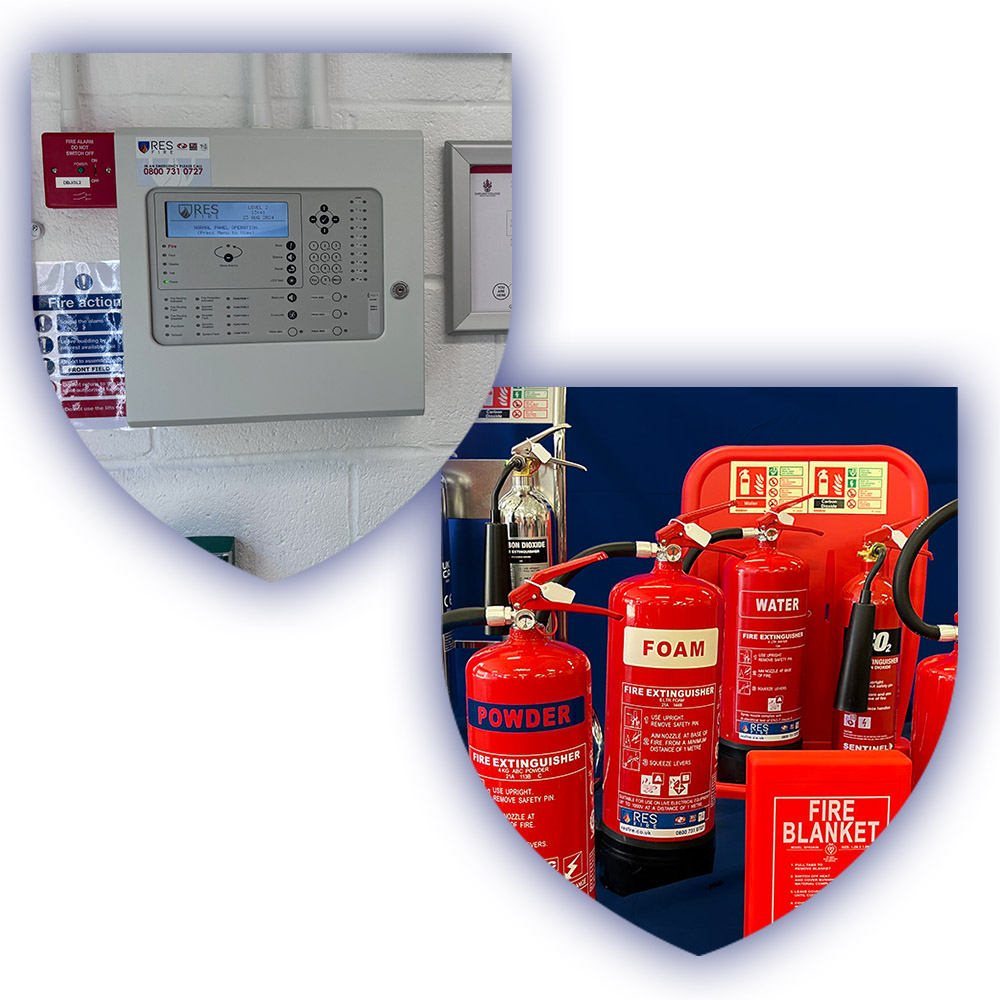
Dual fire extinguisher and fire alarm system servicing and maintenance

Dual fire extinguisher and fire detection and alarm system servicing and maintenance

Combining your servicing

Combining your fire extinguisher servicing and fire detection and alarm system servicing into one visit can reduce your overall annual servicing costs and minimise disruption to your premises.

RES have a dedicated team of “dual” engineers that can service both types of fire safety equipment at your premises.

If we currently service your fire extinguishers and not your fire detection and alarm system, please get in touch to discuss your requirements. Similarly, if we look after your fire detection and alarm system and would like us to service your fire extinguishers, get in touch!

NEW FIRE RISK ASSESSOR COMPETENCY STANDARD PUBLISHED

The British Standards Institute (BSI) has published the long-awaited standard setting out a framework for the assessment of fire risk assessor competency.

BS 8674:2025 Built Environment – Framework for Competence of Individual Fire Risk Assessors 

Designed through industry-wide collaboration to reduce the variability of fire risk assessor qualifications, offer consistency across the sector, and support the professionalisation of fire risk assessors, this new standard will help to drive and improve industry-wide standards.

The publication of this standard sees the government take significant strides towards meeting one of the recommendations made in the Grenfell Tower Inquiry Phase 2 report, namely to “establish a system of mandatory accreditation to certify the competence of fire risk assessors by setting standards for qualification and continuing professional development and such other measures as may be considered necessary or desirable”.

Fire Safety for Property Managers and Facilities Management

Fire Safety for Property Managers and Facilities Management

Ensuring that compliant fire safety procedures and services are in place is an essential part of property management. Your legal responsibilities as a property manager will require you to cover various aspects of compliance such as the service and maintenance of all the fire protection measures in a premises.

As a property manager or facilities manager you should be aware of the requirements necessary to ensure fire safety compliance is achieved across your properties.

We recommend fire risk assessments are carried out by an independent and suitably qualified assessor / company that is not associated to the company responsible for providing the premises fire safety service and maintenance services to avoid any potential conflict of interests. RES do not undertake fire risk assessments for this reason.

The premises fire risk assessment should be kept up to date, detailing the fire safety measures in place with the assessor making recommendations to ensure they are compliant.

Residential properties may have, for example, fire detection and alarm system, emergency lighting, fire doors, dry risers, smoke control systems and portable fire equipment

Fire Detection and Alarm Systems

Fire alarm systems must be serviced every six months as required by British Standard 5839

Various grades of system are appropriate for residential properties, from Grade A, providing the highest level of fire detection and alarm system, to a Grade D1 system.

Various fire alarm equipment is available and more information on these can be found on our fire alarm service page

RES are BAFE SP203-1 certificated for Fire Detection and Alarm Systems: Third-party certificated by BSI, giving you assurance and peace of mind.

Emergency Lighting

Emergency lighting is a requirement in HMOs under British Standard 5266-1 and an engineer should attend site twice a year to complete a full service across all devices.

There are various types of emergency lights which are outlined in our emergency light service page

RES have BAFE SP203-4 Emergency Lighting: Third-party certificated by BSI, giving you assurance and peace of mind.

Fire Doors

Effective fire-resisting doors are vital to ensure occupants are able to evacuate to a safe place.

As per the “Fire Safety (England) Regulations 2022”, routine fire door checks should be undertaken by the responsible person.

Any damage or defects are reported and remedied in a timely manner by the responsible person.

RES are BM-Trada Q Mark registered for fire door maintenance and installation.

Dry Risers

A Dry Riser is a system of pipes and valves installed in tall buildings or building with restricted access that enables the fire brigade to pump water to specific predetermined points within the building.

The buildings “Responsible Person” (RP) is required to maintain the system to BS 9990 – Code of practice for non-automatic fire fighting systems in buildings, and ensure maintenance frequency and procedures are in accordance with BS 9999 – Code of practice for fire safety in the design, management and use of buildings, or as specified  by the buildings Fire Risk Assessment (FRA).

BS 9990 requires the system to undergo an annual static pressure test and inspection and a six monthly visual inspection, by a competent person. Thus ensuring the Dry riser system is maintained and functioning correctly for the fire brigade at all times.

Smoke Control an Ventilation Systems

Smoke control and ventilation systems vent smoke out of a building in the event of a fire and are used in residential, commercial, healthcare or educational premises.

Smoke Vent Systems should be serviced a minimum of once a year as per the RRO (The Regulatory Reform (Fire Safety) Order 2005, article 17) and  BS 7346-8:2013 and relevant parts of BS EN 12101 for Smoke and heat control systems.

RES can provide a comprehensive Smoke Control and Ventilation service.

Fire Extinguishers

The annual servicing of fire extinguishers is a requirement of British Standard 5306

The Regulatory Reform (Fire Safety) Order 2005 states that houses of multiple occupancy (HMOs) should have fire extinguishers installed. The quantity and placement of these would be outlined in the fire risk assessment.

There are various types of fire extinguisher as outlined on our fire extinguishers service page

RES provide a comprehensive fire extinguisher service and are BAFE (SP101) registered, giving you assurance and peace of mind.

Uptick Maintenance Platform

RES use the leading fire and security maintenance platform Uptick, which provides us and our customers with a clear picture of the service schedules, any defects and invoices. Each customer can be provided client portal access which gives accurate and up-to-date information on all their managed properties in once place.

Whether you are managing one, or a portfolio of properties, our service and maintenance services will help to ensure your premises are fire safety compliant.

Contact Us

Call 0800 731 0727

Email: sales@resfire.co.uk

Contact Us

Areas we cover

RES cover the South of England including the counties of Middlesex, Essex, Kent, East Sussex, West Sussex, Surrey, Hampshire, Dorset, Wiltshire, Gloucestershire, Berkshire, Oxfordshire, Buckinghamshire, Hertfordshire including London, Brighton, Portsmouth, Southampton, Winchester, Bristol, and the surrounding towns of Alton, Aldershot, Andover, Basingstoke, Beaconsfield, Bracknell, Cirencester, Egham, Farnham, Guildford, Henley on Thames, High Wycombe, Maidenhead, Marlow, Newbury, Oxford, Poole, Reading, Slough, St Albans, Staines, Swindon, Watford, Windsor, Woking, Wokingham and Worthing.

Premises Fire Safety Signage for Occupants

Premises Fire Safety Signage for Occupants

Common Questions

Common questions often asked are ‘what fire signs does my premises require? and ‘why do we require so many signs?’

Fire safety signs are designed to warn building occupants of any fire hazards, provide information on fire safety equipment and procedures, and give concise instructions about the actions all occupants at anytime should take in the event of a fire. Installing and maintaining fire safety signs is not only essential to saving lives and protecting property, but is also a legal requirement.

Responsible Person

The Health and Safety (Safety Signs and Signals) Regulations 1996 outlines the types of fire signs, their placement, and the importance of maintenance, while the Regulatory Reform (Fire Safety Order) 2005 requires the Responsible Person to take responsibility for fire safety within commercial premises.

The Fire Safety (England) Regulations 2022 which came into effect in England from 23 January 2023 made it a legal requirement for way finding signs to be installed in all high-rise residential buildings in England, including clear markings identifying floor and individual flat numbers to assist the Fire and Rescue Service.

So which fire safety signs does your premises need ?

There are several types of fire safety signs. Carrying out a Fire Risk Assessment, as required by the Regulatory Reform (Fire Safety) Order 2005, should ultimately determine which signs are essential for your premises.

  • Fire exit signs highlight the safest evacuation route and nearest emergency exit of a building.
  • – Fire door signs provide mandatory instructions to ensure effectiveness.
  • – Fire alarm signs highlight the nearest fire alarm and provide information regarding its activation.
  • – Emergency door operation signs offer simple instructions on how to operate emergency exit doors.
  • – Stairway and floor level identification signs enable occupants of multi-storey high-rise buildings to accurately and quickly inform Fire and Rescue Services of the location of a fire and assist firefighters in navigating their way around the building.
  • – Fire assembly point signs show where a building’s assembly point is located to enable evacuees to report to their designated point and identify any missing persons quickly.
  • – Fire extinguisher signs indicate the position and type of extinguishers present in a premises, show the classes of fire they can be used on and how to operate them safely, and help identify any missing extinguishers that need replacing.
  • – Fire equipment signs ensure that equipment is present, and correctly and clearly identified (where provided) to enable firefighters to gain immediate access to facilities such as rising main outlets on arrival at the scene of a fire.
  • – Fire safety notices reinforce important messages of life safety arrangements to occupants.
  • – Fire action notice signs include step-by-step instructions for occupants to follow in the event of a fire.
  • – Hazard signs identify the location of potential hazardous materials or environments.

Further Details and Information

In the event of a fire, smoke and power outages can reduce sign visibility. Photoluminescent signs which function without the need for any additional illumination help maintain their visibility.

RES FIRE supplies high quality, affordable internal and external fire safety signage in a range of different formats and sizes to ensure your premises is compliant.

For further details on fire safety signage audits and maintenance or to ensure your premise emergency escape/exit lighting is fit for purpose please call RES FIRE on 0800 731 0727

For HM Government Wayfinding Regulations go to:
https://www.gov.uk/government/publications/fire-safety-england-regulations-2022/fact-sheet-wayfinding-signage-regulation-8

Article Originally Published by the FIA